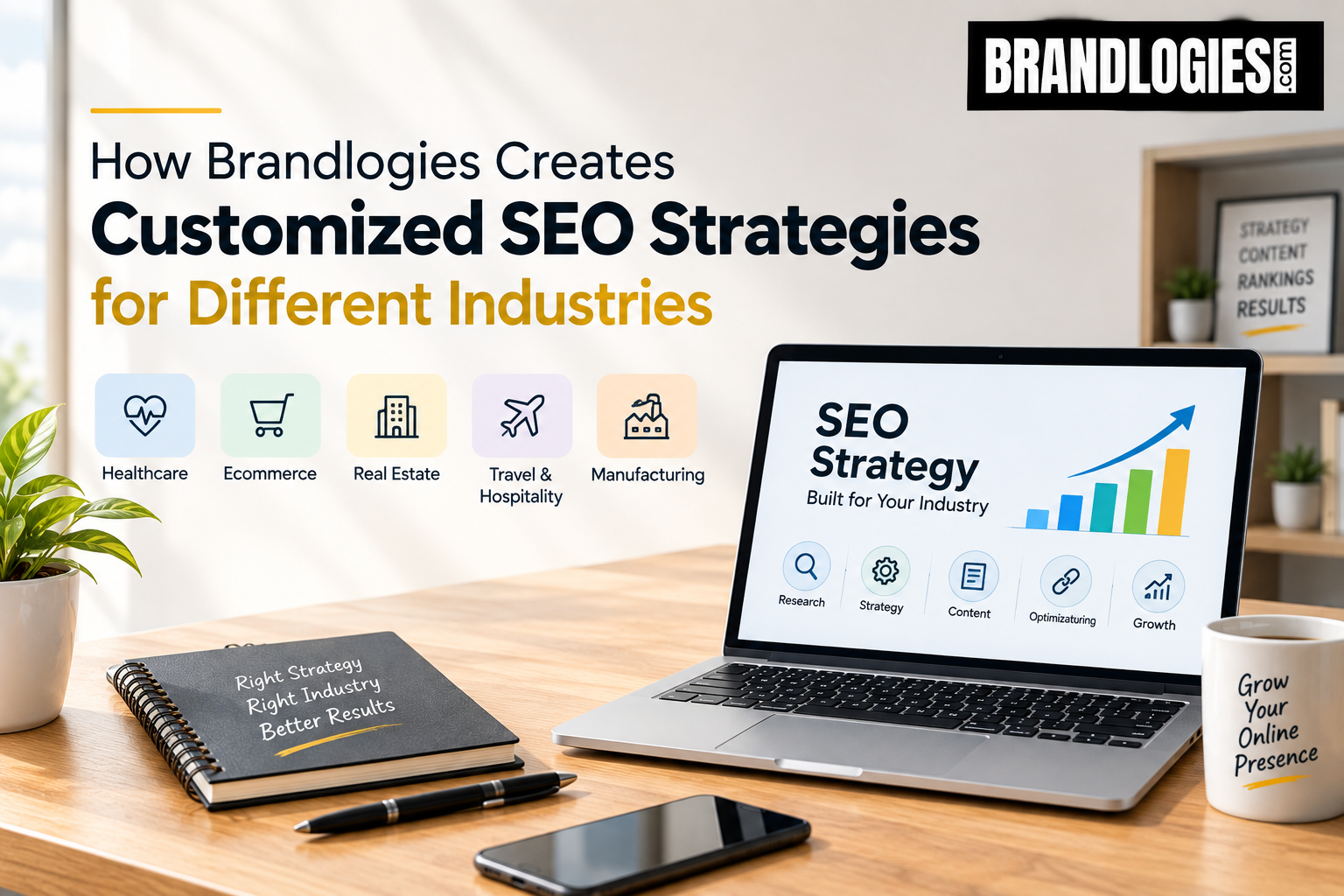
SEO is not a one-size-fits-all marketing strategy. A restaurant, interior design company, hospital, construction business, hotel, ecommerce store, and software company may all want better Google visibility, but their customers search differently, their competition varies, and their conversion goals are not the same.
This is why customized SEO strategies are important for sustainable online growth.
At Brandlogies, SEO planning starts with understanding the business, its customers, services, locations, competitors, and growth objectives. Instead of applying the same checklist to every website, the strategy is adapted to the industry’s specific search behavior and business requirements.
Industry-specific SEO approaches can differ based on local versus national competition, customer journey, trust requirements, and the type of searches customers make.
Why Every Industry Needs a Different SEO Strategy
Consider a restaurant. Its customers may search for “restaurants near me,” “best restaurant in Delhi,” or a specific cuisine. Local visibility, reviews, photographs, menus, and Google Business Profile optimization can be particularly important.
Now consider a B2B software company. Its audience may spend weeks comparing solutions, reading technical content, checking features, and researching alternatives.
The SEO strategy for these businesses should obviously be different.
Brandlogies considers these differences before developing an SEO roadmap.
1. Understanding the Industry and Target Audience
The first step is understanding who the business wants to reach.
Brandlogies studies the products or services offered, ideal customers, locations served, buying journey, common customer questions, and major competitors.
This helps identify what potential customers actually search for instead of relying only on broad, high-volume keywords.
For example, an interior designer may benefit from keywords related to luxury homes, villas, residential interiors, and specific cities. A construction company may need keywords around commercial construction, residential projects, industrial buildings, and project locations.
2. Building Industry-Specific Keyword Strategies
Keyword research is more effective when it reflects actual customer intent.
Brandlogies identifies informational, commercial, local, and transactional keywords relevant to each business.
For a healthcare business, educational and service-specific searches may be important. For ecommerce, product and category searches can play a bigger role. For local businesses, location and “near me” searches may be especially valuable.
The goal is not simply to rank for more keywords. It is to identify searches that can bring relevant visitors and potential customers.
3. Matching Content With Search Intent
Different industries have different customer journeys.
Some customers need an immediate solution, while others compare several businesses before making a decision.
Brandlogies maps content to these different stages.
For example:
Informational search → Educational blog
Commercial search → Comparison or service guide
Transactional search → Product or service page
Local search → Location-focused landing page
This approach helps ensure that users find content that matches what they are actually trying to accomplish.
4. Creating Industry-Relevant Content
Generic content rarely communicates the depth of knowledge required in competitive industries.
Brandlogies develops content around the questions, problems, terminology, and decision factors relevant to each industry.
For a construction company, this could include project planning, construction materials, timelines, and cost considerations.
For a resort, content might focus on destinations, wellness experiences, accommodation options, activities, and travel planning.
For an interior designer, content can cover design styles, materials, budgets, room planning, and project processes.
The content is designed to provide genuine value while supporting relevant search visibility.
5. Adapting Local SEO to the Business
Local SEO is particularly important for businesses serving specific geographic markets.
However, even local strategies should not be identical.
A restaurant may depend heavily on nearby searches and customer reviews. A specialist interior designer may attract customers from a wider service area. A hotel may target travellers searching from other cities and countries.
Brandlogies considers service radius, locations, customer behavior, local competition, and conversion goals when developing local SEO strategies.
6. Building the Right Trust Signals
Different industries require different types of credibility.
Healthcare, finance, legal, and other high-trust sectors require particularly careful attention to expertise and accuracy. Other businesses may benefit more from portfolios, testimonials, reviews, case studies, certifications, or project experience.
Industry-specific SEO therefore includes more than keywords. It also considers the information that helps customers feel confident about choosing a business.
7. Optimizing for Business Goals
Ranking is only one part of SEO.
Brandlogies connects SEO activities with meaningful business outcomes such as:
- Qualified leads
- Phone calls
- Enquiries
- Bookings
- Appointments
- Product sales
- Consultation requests
The right conversion goal depends on the industry.
A restaurant may want reservations, while a SaaS company may want demo requests and an ecommerce business may focus on purchases.
How Brandlogies Creates Customized SEO Strategies
The customized SEO strategies developed by Brandlogies are built around a structured process:
Understand → Research → Analyze → Plan → Optimize → Measure
The process begins with understanding the business and market. Keyword research and competitor analysis then reveal opportunities. Technical SEO, content, local optimization, and conversion improvements are prioritized according to business needs.
Performance is measured continuously so the strategy can be refined as search behavior and business goals evolve.
Final Thoughts
Successful SEO is not about using the same tactics for every website. It is about understanding what makes each business different and building a strategy around those differences.
A local restaurant needs a different approach from a national ecommerce brand. A construction company needs different content from a SaaS platform. A resort needs different search targeting from an interior design firm.
Brandlogies creates customized SEO strategies by connecting industry knowledge, search intent, keyword research, content, local visibility, technical optimization, and conversion goals.
The result is a more focused SEO approach designed not simply to increase website traffic, but to attract the right audience and support long-term business growth.
FAQs
1. Why are customized SEO strategies important?
Customized SEO strategies account for differences in customer behavior, competition, search intent, locations, trust requirements, and conversion goals across industries.
2. Does Brandlogies use the same SEO strategy for every business?
No. Brandlogies adapts SEO planning according to the business’s industry, target audience, services, competition, location, and objectives.
3. How does industry affect keyword research?
Different industries use different terminology and search patterns. Keyword research should reflect how potential customers actually search for products or services within that market.
4. Can customized SEO help local businesses?
Yes. Local businesses can benefit from industry-specific location targeting, Google Business Profile optimization, local content, reviews, and service-area strategies.
5. How does Brandlogies measure SEO success?
Brandlogies can track relevant metrics such as rankings, organic traffic, enquiries, calls, bookings, leads, conversions, and other business-specific goals.
6. Which industries can benefit from customized SEO?
Almost any industry can benefit, including hospitality, healthcare, construction, real estate, interior design, ecommerce, education, automotive, professional services, and technology.
Read Also – Brand SERP Optimization: Controlling Your Online Search Presence