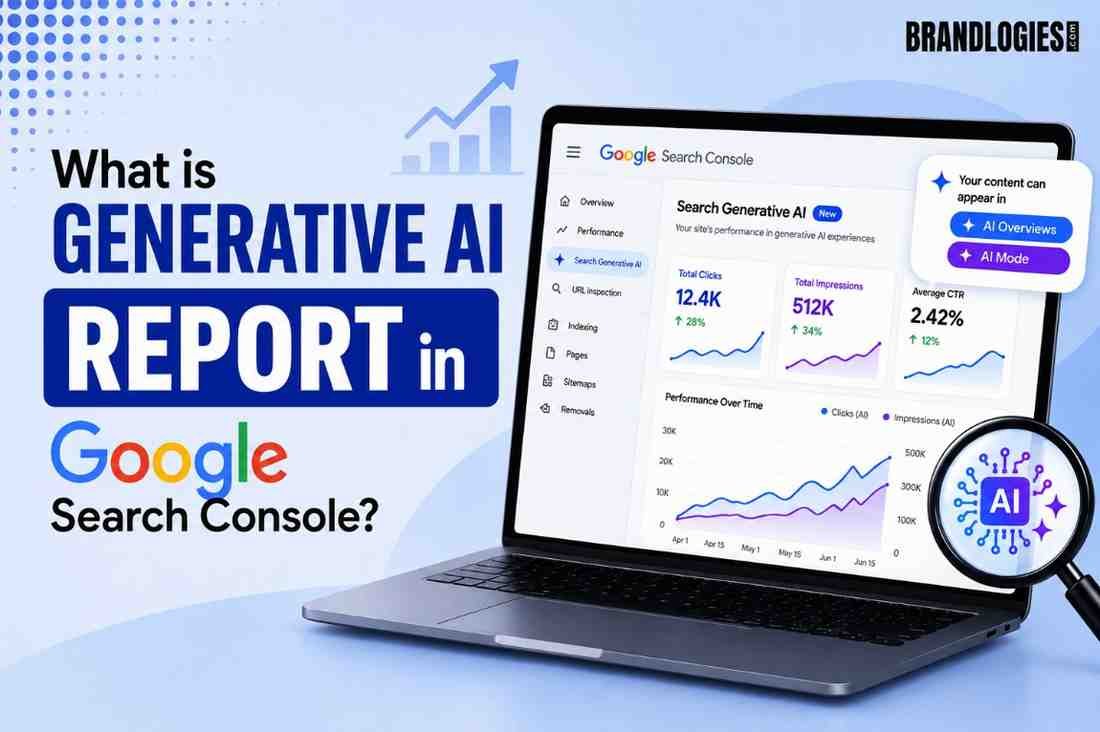
Google Search is evolving beyond traditional blue-link results. With AI Overviews, AI Mode, and other AI-powered search experiences, users can now receive synthesized answers directly within Google Search instead of simply browsing a list of webpages.
This creates a new question for website owners and SEO professionals:
How can you know whether your website is appearing in Google’s AI-powered search experiences?
Google has now introduced Generative AI performance reporting in Google Search Console, giving eligible website owners a dedicated way to understand their visibility across Google’s generative AI experiences.
The new reporting makes it possible to investigate which pages are appearing, where that visibility is coming from, and how performance changes over time.
What Is Google Search Console’s Generative AI Performance Report?
The Generative AI performance report in Google Search Console provides additional insight into how your website appears within Google’s AI-powered search experiences.
Previously, website owners primarily relied on the standard Performance report to understand their Google Search visibility through metrics such as:
- Clicks
- Impressions
- CTR
- Average position
The new generative AI reporting provides a more specific view of visibility associated with Google’s AI search experiences.
This is particularly useful because a website can now be discovered through an AI-generated search experience even when the user isn’t interacting with Google in the same way as a traditional search.
The reporting can help website owners understand their presence in experiences such as:
- AI Overviews
- AI Mode
- Other eligible generative AI experiences in Google Search
- Generative AI experiences in Discover, where applicable
Google has been rolling these reports out to websites in phases, so availability may differ between Search Console properties.
Why Is This Report Important for SEO?
Traditional SEO reporting largely revolves around rankings and organic traffic.
For example:
Keyword → Ranking → Impression → Click → Website
AI-powered search introduces another route through which users can discover information and websites:
Question → AI-generated response → Supporting sources → Website
A website may therefore gain visibility within an AI-powered result even though that visibility doesn’t fit neatly into the traditional idea of a single ranking position.
The new Search Console reporting gives SEO teams another way to evaluate this visibility.
Instead of simply asking:
“What keywords are we ranking for?”
you can also begin asking:
“Which pages from our website are being surfaced in Google’s generative AI experiences?”
That distinction is becoming increasingly important as search behavior changes.
What Data Can You See in the Generative AI Reports?
Google’s new reporting provides several dimensions that can help website owners analyze their AI-search visibility.
1. Impressions
The report shows impressions associated with your website’s appearance in eligible generative AI features.
This can help you understand how frequently your URLs are being exposed to users through AI-powered search experiences.
An impression should primarily be viewed as a visibility metric, rather than automatically treating it as website traffic.
2. Pages
The Pages dimension allows you to identify which URLs from your website appeared in generative AI experiences.
This is particularly valuable for SEO teams.
For example, you may discover that:
- Blog articles are receiving AI visibility
- Service pages are appearing for relevant searches
- Location pages are being surfaced
- Product or category pages are receiving exposure
- Certain content topics consistently generate visibility
This information can help reveal which types of content Google is surfacing in AI-powered search.
3. Countries
The reporting also provides geographic information.
You can analyze visibility by country to understand where your website is appearing in generative AI experiences.
This can be especially useful for businesses targeting multiple markets.
For example, an international website might discover that certain content performs differently across:
- India
- United States
- United Kingdom
- Canada
- Australia
This information can support more targeted international SEO and content strategies.
4. Devices
For Search reporting, device information can help you understand whether AI-related visibility is coming from users on different types of devices.
Comparing desktop and mobile visibility can provide additional context when evaluating your search presence.
5. Dates and Performance Trends
Search Console also allows website owners to analyze performance over time.
Depending on the available reporting granularity, you can examine trends across:
- Hourly periods
- Days
- Weeks
- Months
Looking at trends is generally more useful than focusing on a single day’s numbers.
For example, if a particular content section begins receiving more AI visibility over several weeks, that could indicate growing relevance for the topics covered by that section.
AI Overviews and AI Mode: What’s the Difference?
Understanding Google’s different AI search experiences is important when interpreting this new reporting.
Google AI Overviews
AI Overviews can provide an AI-generated summary within Google Search for eligible queries.
Instead of requiring users to open multiple webpages immediately, Google can synthesize information into a response and provide links to supporting sources.
For example, someone might search:
“How long does SEO take to improve a new website?”
Google may provide an AI-generated explanation covering factors such as website authority, competition, technical SEO, content quality, and search demand.
Relevant websites may be referenced within that experience.
This means a website can gain exposure as a source of information even when the search experience looks different from a traditional results page.
Google AI Mode
AI Mode provides a more conversational search experience.
Users can ask more complex questions and continue with follow-up questions rather than performing every search independently.
For example:
“What are the best digital marketing strategies for a local business?”
A user could then ask:
“Which one works best for a new business?”
And continue with additional questions.
This conversational behavior creates opportunities for websites that provide comprehensive, reliable information around an entire topic rather than targeting only one isolated keyword.
What Does an AI Impression Tell You?
One of the most important things to remember is that visibility and traffic are different metrics.
An AI-related impression indicates that your website has gained visibility within the applicable generative AI reporting.
It doesn’t automatically mean that the user visited your website.
Consider a simple example:
- 10,000 AI-related impressions
- 500 clicks
- 50 leads
These three numbers represent very different stages of the customer journey.
Impressions → Visibility
Clicks → Website visits
Leads → Business outcomes
Therefore, AI reporting should not be evaluated only by looking at the largest impression number.
The more useful question is:
Is AI-related visibility helping the right pages reach the right audience and contribute to meaningful website activity?
Which Website Pages Should You Monitor?
The new reporting can be particularly useful when comparing different types of content.
For example, an SEO team could analyze whether AI visibility is coming primarily from:
- Informational blog posts
- Service pages
- Product pages
- Category pages
- Location pages
- Comparison articles
- How-to guides
- FAQ content
- Industry resources
Suppose a website has 100 blog posts but only 10 consistently receive AI visibility.
Those pages can become useful examples for understanding what type of content is performing well within the site’s broader topical strategy.
However, it is important not to assume that one successful page contains a secret formula for AI visibility.
Google’s AI search systems consider many signals, and there is no guaranteed method for getting a particular URL included in an AI-generated result.
How Should Businesses Use This New Data?
Simply checking the report isn’t enough.
The real value comes from using the data to improve your broader SEO strategy.
1. Identify Pages Already Receiving AI Visibility
Start by identifying URLs that appear in the report.
Look for patterns.
Ask:
- What topics do these pages cover?
- Are they informational or commercial?
- Are they comprehensive?
- Are they updated regularly?
- Do they answer specific user questions?
- Are they supported by other relevant pages on the website?
This can help you understand where your existing content is gaining visibility.
2. Study Your High-Visibility Topics
If several pages around one subject receive AI visibility, look at that topic as a whole.
For example, a website about accounting might find visibility across content covering:
- CPA services
- Tax planning
- Bookkeeping
- Business accounting
- Financial reporting
Instead of treating each article separately, the business can evaluate whether it has built strong topical coverage around the subject.
3. Compare Visibility With Clicks
AI visibility does not automatically translate into visits.
Compare AI-related impressions with clicks and other website performance metrics available to you.
A page with substantial visibility but limited traffic may require further investigation.
Possible areas to review include:
- Page title
- Search intent alignment
- Content depth
- Internal linking
- Calls to action
- Page experience
- Relevance to the target audience
4. Analyze Geographic Trends
For businesses serving multiple locations, country-level data can provide useful insights.
If a company targets India, the UK, and the US, for example, it can examine whether its AI-search visibility is concentrated in one market.
This can help inform future content localization and international SEO decisions.
5. Monitor Changes Over Time
Don’t make major SEO decisions based on a few days of data.
AI-powered search is still evolving, and visibility can fluctuate.
Instead, monitor trends over weeks and months.
Look for sustained changes such as:
- Increasing AI visibility
- Declining visibility
- New pages entering the report
- Previously visible pages losing exposure
- Changes in geographic distribution
Does This Mean SEO Has Changed Completely?
No.
The arrival of generative AI reporting does not mean traditional SEO is no longer important.
Google Search still depends on fundamental website and content quality signals.
Businesses should continue investing in:
- Technical SEO
- Crawlability
- Indexing
- Internal linking
- Helpful and original content
- Page experience
- Mobile usability
- Structured data where appropriate
- Website performance
- Strong information architecture
- Relevant authority and reputation
Generative AI visibility should be considered an additional layer of search performance, not a replacement for SEO fundamentals.
A technically weak website with poor content is unlikely to become successful simply because it publishes content specifically labeled as “AI SEO.”
How Can You Improve Your Website’s Visibility in AI Search?
There is no official checklist that guarantees inclusion in AI Overviews or AI Mode.
Instead, businesses should focus on creating content that genuinely satisfies user needs.
Answer Questions Clearly
Don’t make users search through five paragraphs to find the answer.
Start important sections with clear explanations and then provide supporting detail.
Build Topic Depth
Instead of producing dozens of unrelated articles, build useful coverage around subjects that matter to your audience.
For example, a dental clinic could create connected resources covering:
- Dental implants
- Implant eligibility
- Implant procedure
- Implant recovery
- Implant costs
- Implant maintenance
This creates a stronger overall topical resource than publishing isolated articles with little connection between them.
Demonstrate First-Hand Knowledge
Content should demonstrate real expertise rather than simply repeating information found elsewhere.
Where appropriate, include:
- Expert insights
- Original data
- Practical examples
- Relevant experience
- Clear explanations
- Sources for important claims
Keep Information Updated
Outdated information can reduce the usefulness of content.
Review important pages periodically and update information when services, regulations, technology, statistics, pricing, or industry practices change.
Make Content Easy to Understand
Clear structure benefits both users and search engines.
Use:
- Descriptive headings
- Short paragraphs
- Bullet points
- Tables where useful
- Relevant examples
- Direct answers
- Logical internal links
The objective should be to make the information easy to understand—not to write specifically for an AI system.
What Should SEO Professionals Track Now?
The new reporting expands the range of information SEO teams can consider.
A modern SEO dashboard can potentially look beyond traditional metrics and evaluate several layers of visibility.
| Traditional SEO | Generative AI Visibility |
| Clicks | AI impressions |
| Organic impressions | AI-visible URLs |
| CTR | AI-related clicks |
| Average position | Countries |
| Keyword rankings | Devices |
| Organic traffic | Visibility trends |
These metrics should not be treated as completely separate SEO worlds.
Instead, they can provide complementary information about how people discover your website through Google’s evolving search experiences.
The Bigger Change: From Rankings to Search Visibility
One of the biggest changes brought by AI-powered search is that website visibility is becoming broader than a single ranking position.
In traditional SEO, marketers often ask:
“Are we ranking in position one?”
That question is still important.
But AI-powered search adds another:
“Is our content being recognized as a useful source when Google generates answers for relevant searches?”
The new Search Console reporting gives website owners a way to start measuring that second type of visibility.
This makes the feature particularly valuable for SEO professionals who need to understand how their content is performing as Google’s search experience continues to evolve.

Frequently Asked Questions
1.What is the Generative AI report in Google Search Console?
It is a dedicated reporting view that provides information about a website’s visibility in eligible generative AI experiences across Google Search and, where applicable, Discover.
2.Does Google Search Console now show AI Overviews?
The new generative AI reporting provides visibility data associated with eligible generative AI features, including experiences such as AI Overviews and AI Mode.
3.Does an AI impression mean someone visited my website?
No. An impression represents visibility, while a click represents a user selecting a result and visiting your website. These should be analyzed separately.
Can I see which pages appear in AI search?
Yes. The new reporting includes page-level information that can help you identify URLs receiving visibility within the applicable generative AI experiences.
4.Can I see which countries generate AI visibility?
Yes. Country-level reporting allows website owners to understand where their generative AI visibility is coming from.
5.Does Google guarantee that optimized content will appear in AI Overviews?
No. There is no guaranteed method for getting a specific page included in an AI-generated result. Websites should continue following Google’s general SEO and content-quality principles.
6.Should businesses stop focusing on traditional SEO?
No. Technical SEO, useful content, crawlability, indexing, internal linking, website performance, and overall search quality remain important. Generative AI visibility should be viewed as an additional part of modern search performance.
Final Thoughts
Google’s Generative AI performance reporting marks an important development in how website owners can measure search visibility.
As users increasingly interact with AI Overviews and AI Mode, traditional ranking reports alone may not provide the complete picture of how a website is discovered through Google.
The new Search Console reports give businesses an opportunity to identify which pages are appearing in generative AI experiences, where that visibility is occurring, and how it changes over time.
For SEO professionals, the next step isn’t to abandon traditional SEO or chase every new AI trend.
It is to combine strong SEO fundamentals with better analysis of how content is being discovered across Google’s evolving search experiences.
Search is changing. The way we measure search visibility needs to evolve with it.
Read Also – What Are Google AI Overviews and How Do They Work?