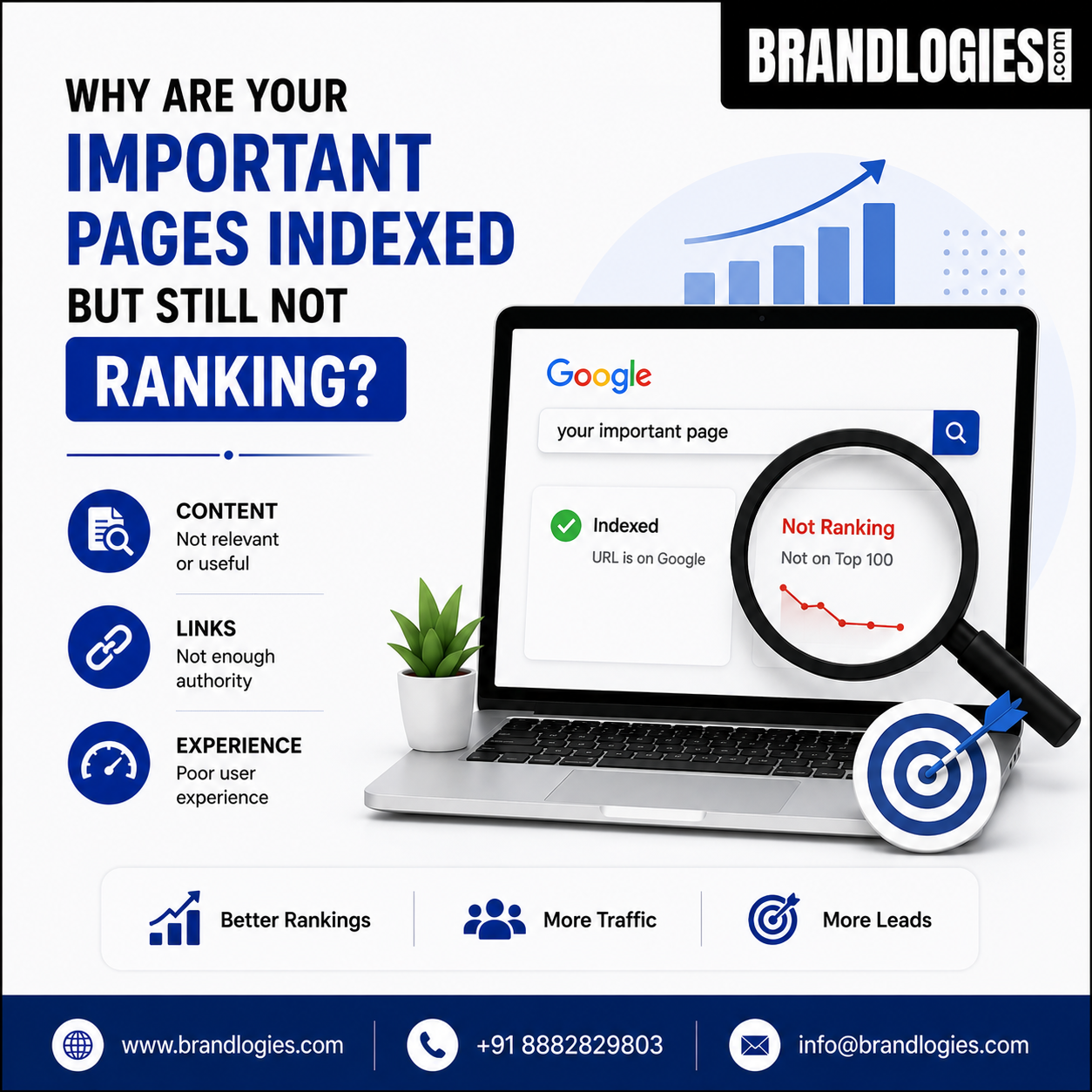
Getting an important website page indexed by Google is a positive step, but indexing does not guarantee rankings. Many businesses discover that their service pages, product pages, or location pages appear in Google’s index but receive little or no organic traffic.
So, why are your important pages indexed but still not ranking?
The problem can come from search intent, content quality, competition, internal linking, backlinks, technical SEO, or overall website authority. Understanding the reason can help you make focused improvements instead of simply publishing more content.
At Brandlogies, we help businesses look beyond indexing and understand what prevents important pages from gaining meaningful search visibility.
What Does Indexed but Not Ranking Mean?
When Google indexes a page, it has discovered and stored that page in its search database. However, Google still needs to determine whether the page deserves to appear prominently for a particular search query.
A page can therefore be:
- Indexed but ranking beyond the first page
- Indexed but ranking for irrelevant keywords
- Indexed but receiving very few impressions
- Indexed but competing with another page on the same website
Indexing is the beginning of the ranking process, not the final goal.
1. Your Page May Not Match Search Intent
One of the most common reasons important pages fail to rank is poor search intent alignment.
For example, if users searching for “SEO services in Delhi” primarily see agency service pages, but your page is a general educational article about SEO, it may not satisfy what Google believes searchers want.
Before optimizing a page, examine the current search results.
Ask:
- What type of pages are ranking?
- What information do they provide?
- Are they local, commercial, informational, or transactional?
- Does your page satisfy the same user need?
Your content should closely match the purpose behind the search.
2. The Content May Not Be Strong Enough
Being indexed does not mean your content is comprehensive or competitive.
Thin, generic, outdated, or repetitive content may struggle against pages that provide more useful information.
Review your important pages and improve areas such as:
- Original insights
- Clear explanations
- Helpful examples
- Relevant statistics or evidence
- FAQs
- Service details
- Updated information
- Clear answers to user questions
Avoid adding unnecessary words just to make a page longer. Quality and usefulness matter more than word count.
3. Your Page May Be Targeting a Highly Competitive Keyword
Sometimes the page is good, but the keyword is extremely competitive.
A new or relatively small website may struggle to rank immediately for broad terms dominated by established brands and authoritative websites.
Instead of targeting only highly competitive keywords, build visibility around relevant long-tail and location-based searches.
For example, instead of focusing only on “digital marketing,” a business might target more specific searches related to its services, audience, industry, or location.
This can create opportunities to attract more qualified visitors.
4. Internal Linking May Be Weak
Google uses links to discover relationships between pages and understand website structure.
If an important page has very few internal links pointing toward it, it may receive less attention compared with well-connected pages.
Review your website structure and link relevant pages together.
For example:
SEO Guide → SEO Services → Local SEO Services → Location Page
Use descriptive anchor text where appropriate and make sure important commercial pages are easy to discover from other relevant sections of your website.
5. Your Website May Lack Authority
Competitive search results often contain websites with strong authority and relevant backlinks.
If your important page has useful content but competitors have stronger websites, more quality backlinks, and greater topical authority, ranking can take longer.
Focus on building authority naturally through:
- High-quality backlinks
- Digital PR
- Industry mentions
- Expert contributions
- Useful original content
- Strong topical coverage
Do not focus on acquiring large numbers of low-quality links. Relevance and quality are more important.
6. Another Page May Be Competing With It
Sometimes Google indexes several pages from the same website that cover almost the same topic.
This can create keyword overlap and make it difficult for Google to determine which page should rank.
Review pages targeting similar keywords and decide whether they should be:
- Combined
- Improved
- Redirected
- Differentiated
- Internally linked more strategically
A clear content structure helps search engines understand which page is the primary resource for a topic.
7. Technical Issues Can Still Matter
Even when a page is indexed, technical problems may affect its ability to perform well.
Check:
- Page speed
- Mobile usability
- Canonical tags
- Structured data
- Internal links
- JavaScript rendering
- Page experience
- Indexability signals
Technical SEO does not automatically make a page rank, but technical problems can prevent your content from performing at its full potential.
How Brandlogies Can Help
If your important pages are indexed but not generating traffic, randomly changing titles or adding keywords may not solve the problem.
Brandlogies can help identify the underlying SEO issues by analyzing search intent, content quality, keyword targeting, internal linking, competition, technical factors, and website authority.
The goal is to understand why a page is underperforming and create a practical strategy to improve its search visibility.
Final Thoughts
An indexed page is not necessarily a ranking page.
If your important pages are indexed but still not ranking, look beyond indexing status. Check whether the page matches search intent, provides enough value, targets realistic keywords, has strong internal links, and competes effectively against existing results.
SEO success comes from making the right page the best possible answer for the right search.
With a structured approach, Brandlogies can help businesses turn underperforming indexed pages into stronger opportunities for organic visibility, qualified traffic, and leads.

FAQs
1. Why is my page indexed but not ranking?
A page may be indexed but not ranking because of weak search intent alignment, poor content quality, high keyword competition, weak internal links, limited authority, or technical issues.
2. Does indexing mean my page will rank?
No. Indexing only means Google has stored the page in its search index. Ranking depends on many other factors, including relevance, quality, competition, authority, and search intent.
3. How long does it take for an indexed page to rank?
There is no fixed timeframe. Ranking can depend on website authority, competition, content quality, query intent, backlinks, and how Google evaluates the page over time.
4. Should I add more keywords to a page that is not ranking?
Not necessarily. Keyword stuffing can make content less useful. First, check search intent, content quality, topical coverage, internal linking, and competition.
5. Can Brandlogies help improve pages that are indexed but not ranking?
Yes. Brandlogies can analyze underperforming pages and identify opportunities across content, keywords, technical SEO, internal linking, search intent, and authority building.
Read Also – Why Is My Competitor Ranking Higher on Google Maps?