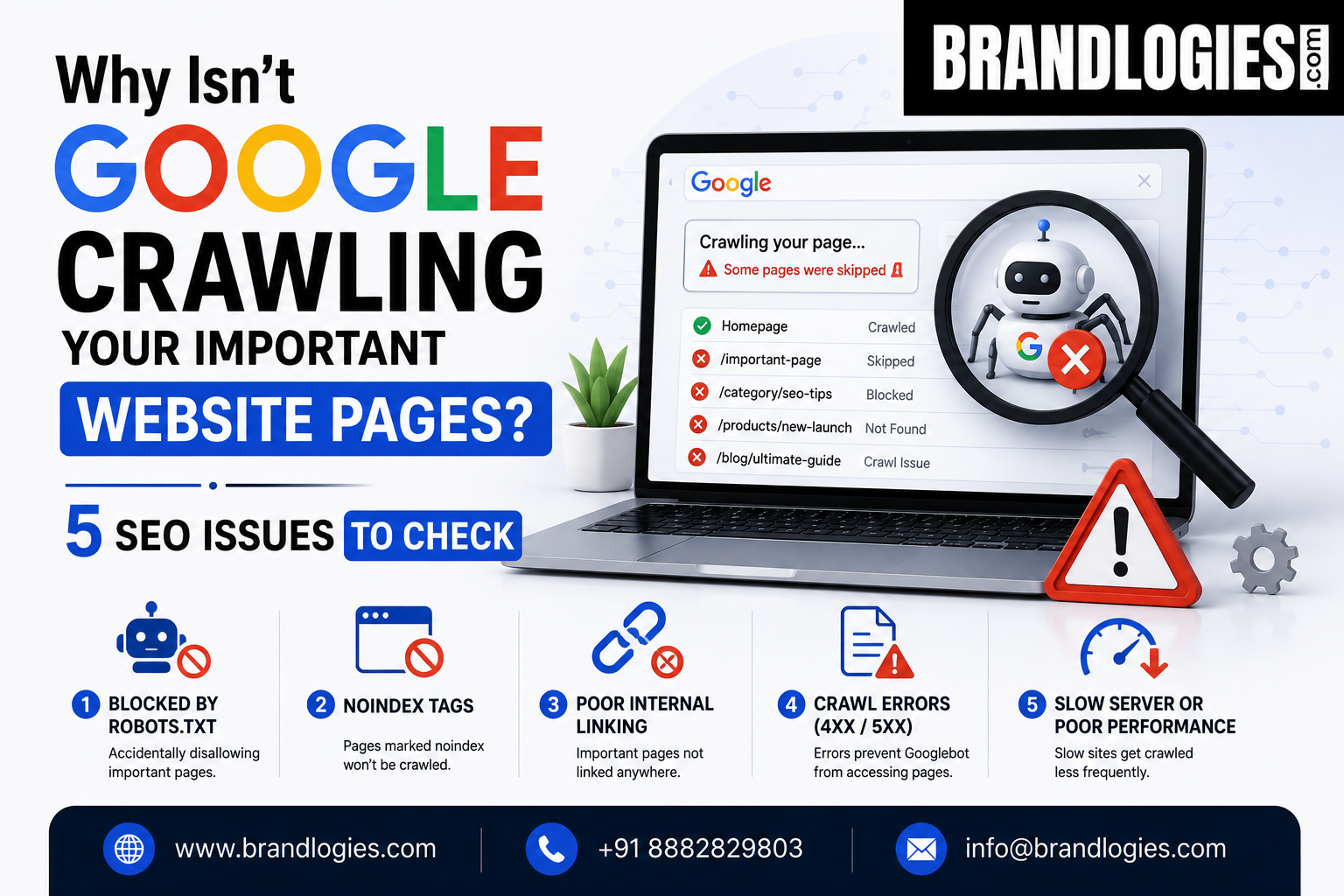
You publish a new service page, product page, or important blog and expect Google to discover it. Days or even weeks later, the page still does not appear in search.
This can be frustrating, especially when other pages on your website are being indexed normally. In many cases, the problem is not the quality of the page itself. Google crawling issues can occur because of technical settings, website structure, server problems, or signals that prevent search engines from efficiently discovering important URLs.
Understanding why Google is not crawling your pages is the first step toward fixing the problem. Here are five SEO issues worth checking.
1. Your Robots.txt File May Be Blocking Crawlers
The robots.txt file tells search engine crawlers which areas of your website they should or should not access.
An incorrectly configured rule can accidentally block important pages or entire sections of a website.
For example, a poorly configured robots.txt file may prevent Googlebot from accessing a directory containing valuable service or product pages.
Review your robots.txt file and make sure important sections are not unintentionally disallowed. Remember that robots.txt is primarily a crawling instruction; it is not a reliable method for removing a page from Google’s index.
At Brandlogies, we recommend checking robots.txt whenever important pages suddenly stop being discovered or crawled.
2. Your Pages May Not Have Strong Internal Links
Google often discovers new pages through links from other pages it already knows about.
If an important page has no internal links pointing toward it, search engines may have difficulty discovering it. This is especially common with pages that are published but not added to the site’s navigation, category structure, or related content.
Create logical internal links from relevant pages.
For example, if you publish a page about local SEO services, link to it naturally from related articles about local search, Google Business Profile optimization, and SEO strategy.
A well-connected website makes important pages easier for both users and search engines to find.
3. Your XML Sitemap May Be Incorrect
An XML sitemap provides search engines with a list of URLs you consider important.
If your sitemap is outdated, contains broken URLs, includes redirected pages, or excludes newly published content, Google may not receive the strongest discovery signals.
Check that your sitemap:
- Contains important canonical URLs
- Excludes unnecessary or broken pages
- Is updated when new pages are published
- Can be accessed successfully
- Is submitted through Google Search Console
A sitemap does not guarantee crawling or indexing, but it can help Google discover important URLs more efficiently.
4. Your Website May Have Technical or Server Problems
Sometimes Google cannot crawl a page because the website itself is creating obstacles.
Server errors, slow responses, frequent downtime, incorrect redirects, or blocked resources can interfere with crawling.
Check your server response codes and review Google Search Console for crawl-related warnings. Pay attention to errors such as 5xx server responses, redirect problems, and pages returning unexpected status codes.
Website performance also matters. If important pages take too long to respond, search engine crawlers may have difficulty accessing them efficiently.
Technical SEO should therefore be treated as an ongoing process rather than a one-time task.
5. Your Website Structure May Be Too Deep or Complicated
Important pages should not be buried several clicks away from your homepage.
If a valuable service page can only be reached through multiple layers of navigation, it may be less discoverable than a page that is directly connected to relevant sections of the website.
Review your website architecture and organize pages into clear categories.
A simple structure might look like:
Homepage → Services → SEO Services → Local SEO
This makes the relationship between pages easier to understand.
Use descriptive anchor text and connect related pages wherever it makes sense. Avoid creating unnecessary layers simply to accommodate keywords.
Crawling Is Not the Same as Indexing
One important distinction is that crawling and indexing are different processes.
Crawling means Google discovers and accesses a URL. Indexing means Google processes the page and decides whether it should be included in its search index.
A page can therefore be crawled without being indexed.
If Google has discovered your page but it remains unindexed, investigate other potential issues such as duplicate content, canonicalization, low-value content, or indexing directives.
Google Search Console can help you determine which stage is causing the problem.
How Brandlogies Can Help
If important website pages are not being discovered, randomly publishing more content is unlikely to solve the underlying problem.
Brandlogies can help businesses identify technical SEO issues, review website architecture, improve internal linking, evaluate indexing signals, and develop a stronger search visibility strategy.
Start by checking robots.txt, internal links, your XML sitemap, server responses, and website structure. These five areas can reveal many common causes of Google crawling issues.
Once important pages are accessible and discoverable, you can focus on the next stage: making those pages valuable enough to earn strong search visibility.

FAQs
1. Why is Google not crawling my website pages?
Common reasons include blocked crawling directives, weak internal linking, sitemap problems, server errors, complicated website architecture, or limited discovery signals.
2. How do I know if Google has crawled a page?
You can use Google Search Console’s URL Inspection tool to check the current indexing and crawling status of an individual URL.
3. Does submitting a sitemap guarantee crawling?
No. A sitemap helps Google discover URLs, but it does not guarantee that every submitted page will be crawled or indexed.
4. What is the difference between crawling and indexing?
Crawling is when Google accesses and processes a URL. Indexing is the process of evaluating and potentially storing that page in Google’s search index.
5. Can Brandlogies fix Google crawling issues?
Yes. Brandlogies can help identify technical SEO problems, improve website structure and internal linking, review crawlability signals, and build a strategy for stronger organic search visibility.
Read Also – Why Ranking #1 Isn’t Enough Anymore: The New SEO Reality