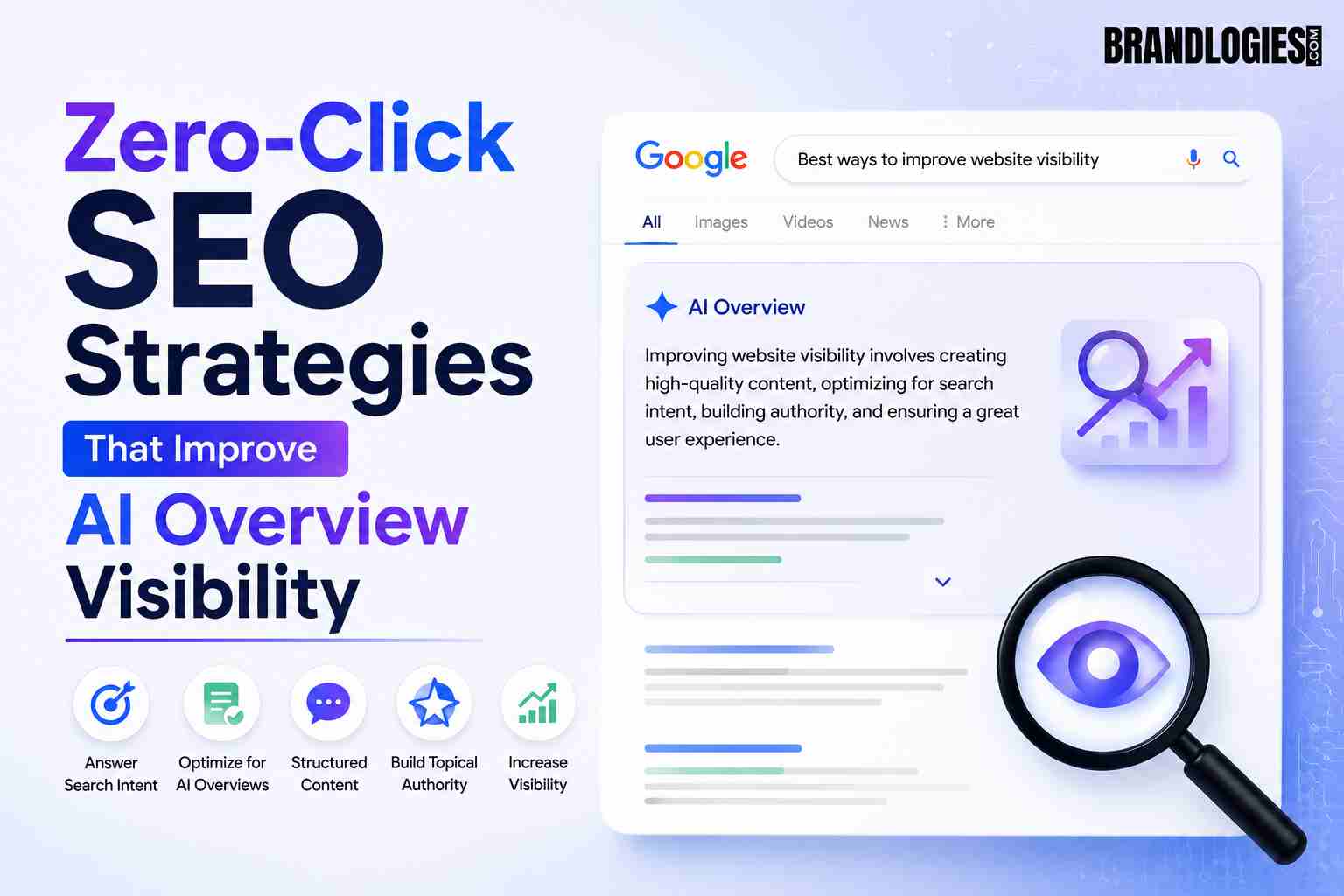
Zero-click search strategies help websites stay visible even when a searcher never clicks through to a result — because in 2026, most searches end that way. A zero-click search happens when Google answers a query directly on the results page, through AI Overviews, featured snippets, knowledge panels, or instant answer boxes, satisfying the user before they ever reach an external site. Industry data consistently shows that a majority of searches now end without a single click, and that share keeps climbing as AI Overviews expand across more query types. For businesses and content creators, this means visibility can no longer be measured by clicks alone — it has to include how often your brand appears inside the answer itself.
What Is a Zero-Click Search?
A zero-click search is any query where the searcher gets a complete answer without leaving the search results page. Common examples include:
- Asking for a quick conversion, like currency or measurements
- Checking the weather or a sports score
- Getting a definition through a featured snippet
- Reading a synthesized response inside an AI Overview
These interactions satisfy the user’s intent instantly, which means the website that supplied the information often gets no visit at all — only a citation, if that.
Why Zero-Click Search Keeps Growing
Zero-click behavior isn’t new; featured snippets and knowledge panels have been absorbing clicks for years. What’s changed is the pace. AI Overviews now generate synthesized answers for a large share of informational queries, and Google has increasingly focused on resolving searcher intent inside its own interface rather than sending traffic outward. Many SEO professionals point to this as the biggest structural shift in search since featured snippets first appeared, since it compresses years of gradual change into a much shorter window.
Expert Tip
Stop measuring a page’s success by click-through rate alone. Track how often it appears inside AI Overviews, featured snippets, or People Also Ask boxes — that visibility often drives branded searches and direct traffic days later, even without an initial click.
Zero-Click SEO vs Traditional SEO
| Feature | Traditional SEO | Zero-Click SEO |
|---|---|---|
| Primary goal | Drive clicks to your website | Earn visibility inside the SERP itself |
| Success metric | Rankings, organic sessions, CTR | Citations, SERP feature share, branded search lift |
| Content format | Long-form pages built for depth | Answer-first content built for extraction |
| Best for | Comparison and high-intent queries | Definitions, quick facts, awareness-stage queries |
Strategies That Actually Work
Lead With a Direct Answer
Open your content with a concise, standalone answer — roughly 40 to 60 words — placed within the first 100 words of the page. It should make sense on its own, without needing the rest of the article for context. This is the format AI Overviews and featured snippets are built to extract.
Structure Content for Extraction
Use clear headers, short paragraphs, bullet lists, and comparison tables. Search engines and AI models both favor content that’s easy to parse and pull apart into standalone pieces, rather than dense blocks of text.
Strengthen Entity Signals
Consistent branding, structured data, and clear author or organization information help search engines understand who you are and whether to trust your content enough to cite it. This matters as much as keyword targeting now.
Choose Your Battles
Not every keyword deserves a zero-click strategy. High-intent buyer queries and comparison searches often still reward click-through content, since the searcher wants more than a quick fact. Simple definitional queries, on the other hand, are usually better served by an answer-first format designed purely for visibility.
Track Assisted Value, Not Just Clicks
A user who sees your brand cited in an AI Overview may not click that day — but they might search your brand name directly a week later and convert. Building this kind of assisted-conversion tracking into your reporting gives a far more accurate picture than click volume alone.
Common Mistakes to Avoid
- Chasing every keyword with the same content format, instead of matching the format to the intent
- Measuring success only by organic sessions, missing the brand-visibility value of citations
- Burying the answer under introductions and disclaimers, making content harder for AI systems to extract
- Ignoring structured data, which weakens entity signals search engines rely on for trust
Many businesses work with experienced digital marketing agencies like Brandlogies to rebuild their measurement frameworks around visibility, not just traffic, as zero-click search becomes the norm.
Building a Visibility-First SEO Strategy
Zero-click search isn’t a temporary side effect of AI — it’s the direction search has been heading for years, and AI Overviews have simply accelerated it. The websites that adapt well treat citations, brand mentions, and SERP feature appearances as real outcomes worth optimizing for, not consolation prizes. That means restructuring content around direct answers, strengthening entity signals, and measuring success by visibility and assisted conversions, not clicks alone. Search isn’t disappearing — it’s just rewarding a different kind of presence.
Frequently Asked Questions
1. What is a zero-click search? It’s a search where the user gets their answer directly on the results page without visiting any website.
2. Are zero-click searches bad for SEO? Not inherently — they reduce direct traffic but can build brand visibility and trust when your content gets cited.
3. How do I optimize for zero-click search? Lead with a concise, standalone answer early in your content, and structure the rest with clear headers and lists.
4. Does zero-click search affect e-commerce sites? Yes, though transactional queries still tend to drive more clicks than purely informational ones.
5. What’s the difference between zero-click SEO and traditional SEO? Traditional SEO optimizes for clicks and rankings; zero-click SEO optimizes for visibility inside the search results themselves.
6. Can I track zero-click performance in Google Search Console? Yes, comparing impressions against clicks for a query can reveal how often it’s being answered without a visit.
7. Should I stop creating long-form content? No — long-form content still works well for comparison and high-intent queries; just pair it with a strong answer-first opening.
8. What SERP features cause zero-click results? AI Overviews, featured snippets, knowledge panels, and instant answer boxes are the main contributors.