Introduction
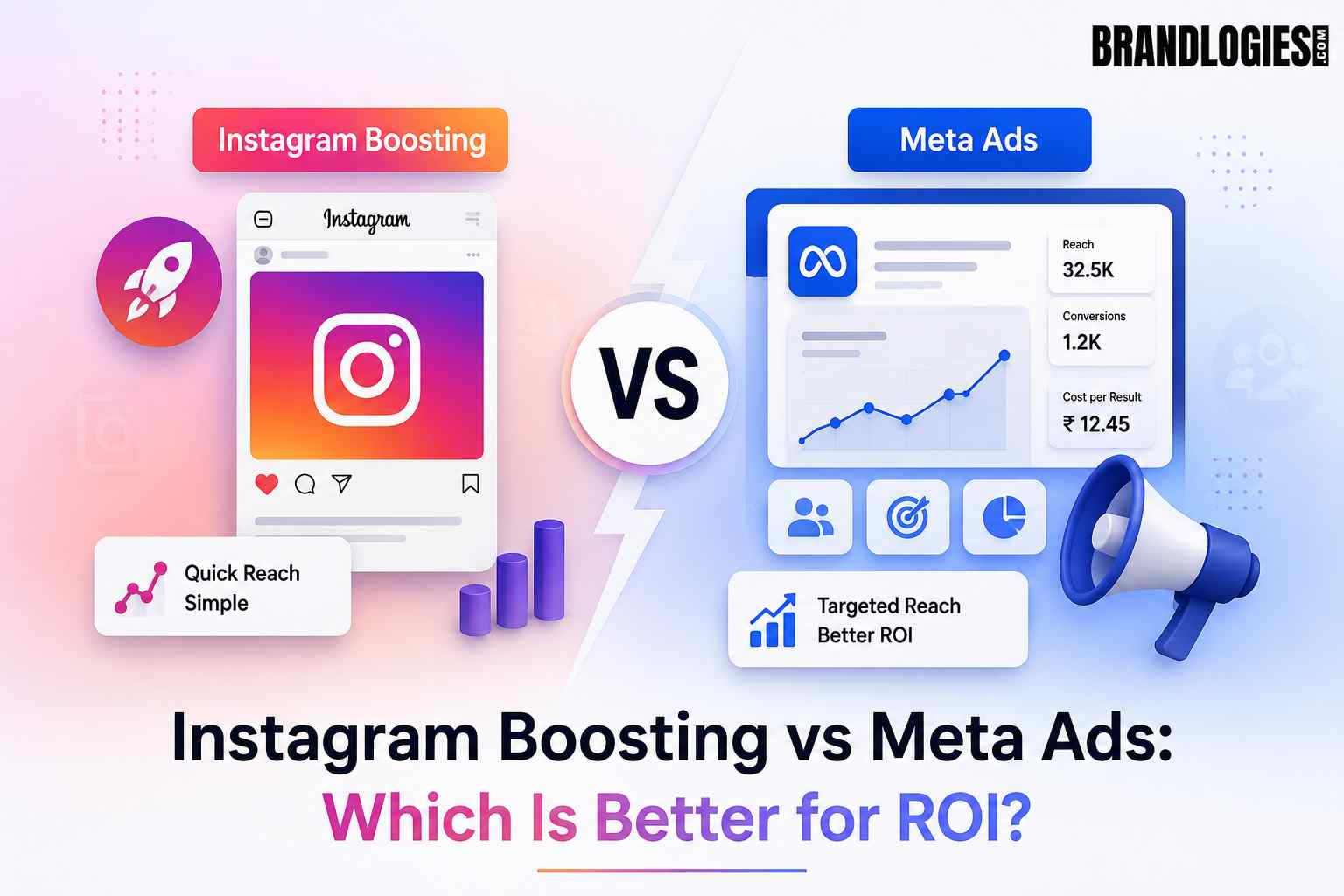
Instagram boosting vs Meta Ads comes down to a simple trade-off: speed and simplicity versus control and measurable return. Boosting lets you pay to push an existing Instagram post to more people in just a few taps, directly from the app. Meta Ads, run through Ads Manager, gives you full control over campaign objectives, audience targeting, placements, and conversion tracking. For pure ROI — meaning a clear, trackable return on ad spend — Meta Ads consistently wins once you’re spending real budget or chasing a specific business outcome like leads or sales. Boosting still has its place, but mainly for quick visibility and social proof, not for campaigns where every dollar needs to be accountable.
What Is Instagram Boosting?
Boosting is a simplified promotion feature built directly into the Instagram and Facebook apps. You pick an existing post, set a budget and duration, choose a broad goal like more profile visits or engagement, and Instagram handles the rest. It’s fast, beginner-friendly, and requires no separate setup.
The trade-off is control. Boosting offers limited targeting options, no access to advanced placements like Messenger or the Meta Audience Network, and only basic performance insights — reach, likes, and comments, rather than real conversion data.
What Is Meta Ads (Ads Manager)?
Meta Ads run through Ads Manager, the full advertising platform behind Facebook, Instagram, Messenger, and Threads. It supports specific campaign objectives — conversions, leads, traffic, video views — along with detailed audience targeting, including lookalike audiences and retargeting based on website visitors or customer lists.
Ads Manager also unlocks additional placements boosting doesn’t offer, like Facebook Feed side ads and Instagram Stories, plus pixel-based conversion tracking that connects ad spend directly to actual revenue. That tracking is what makes Meta Ads far easier to evaluate for genuine ROI.
Expert Tip
Before boosting a post, ask whether you actually need a conversion — a sale, a lead, a signup. If the answer is yes, skip boosting entirely and build the campaign in Ads Manager from the start, since boosting has no reliable way to track whether it drove that outcome.
Instagram Boosting vs Meta Ads: Side-by-Side
| Feature | Instagram Boosting | Meta Ads (Ads Manager) |
|---|---|---|
| Setup time | Minutes, inside the app | Longer, requires campaign structure |
| Targeting | Basic (age, location, interests) | Advanced (lookalikes, retargeting, custom audiences) |
| Objectives | Reach, engagement, profile visits | Conversions, leads, traffic, video views, and more |
| Placements | Instagram feed only | Feed, Stories, Messenger, Audience Network |
| Conversion tracking | Minimal to none | Pixel-based tracking tied to revenue |
| Best for | Quick visibility, social proof | Measurable, scalable ROI |
When Boosting Still Makes Sense
Boosting isn’t without value — it just fits a narrower set of goals:
- Extending the life of a post that’s already performing well organically, amplifying signal that’s already there
- Low-budget, single-shot pushes where setting up a full campaign wouldn’t be proportionate to the outcome
- Warming up an audience before launching a more structured Meta Ads campaign
- Building social proof through more likes and comments on a post before a bigger push
When Meta Ads Clearly Wins on ROI
Once spending crosses a meaningful monthly threshold, or the goal shifts from visibility to a specific action, the gap between boosting and Ads Manager widens fast. Meta Ads supports full-funnel structures — cold audiences, retargeting, lookalikes — and lets you track cost-per-result down to the individual objective. For any campaign where you need to prove ROI to a client, a manager, or yourself, Ads Manager is the only option built to answer that question directly.
Common Mistakes to Avoid
- Boosting posts to drive sales, when the feature simply isn’t built for reliable conversion tracking
- Jumping straight into Ads Manager without a clear objective, which leads to wasted spend just as easily as boosting does
- Ignoring the cost-per-engagement gap once monthly spend grows past a few hundred dollars
- Treating boosting and Ads Manager as competitors, rather than using boosting as an early step before a full campaign
Many businesses work with experienced digital marketing agencies like Brandlogies to build out full-funnel Meta Ads structures once boosting alone stops delivering measurable returns.
Choosing the Right Approach for Your Budget
The decision isn’t really about picking a side permanently — it’s about matching the tool to the goal and the budget. Use boosting for quick engagement, social proof, or testing which organic posts deserve more attention. Move to Ads Manager the moment you need a specific, trackable outcome, or once your monthly spend makes the lack of targeting and reporting in boosting too costly to ignore. The businesses seeing the strongest ROI on Meta platforms are rarely the ones boosting posts long-term — they’re the ones who treat Ads Manager as the real system for growth.
Frequently Asked Questions
1. Is Instagram boosting worth it for ROI?
Boosting can build reach and engagement, but it lacks the conversion tracking needed to reliably measure ROI.
2. What’s the main difference between boosting and Meta Ads?
Boosting is a simplified, app-based promotion tool, while Meta Ads (Ads Manager) offers full campaign control, targeting, and conversion tracking.
3. When should I switch from boosting to Ads Manager?
Once you’re spending meanina gful monthly budget or need a specific outcome like leads or sales, not just visibility.
4. Can beginners use Meta Ads Manager?
Yes, though it requires some basic training to understand campaign structure and optimization settings.
5. Does boosting offer retargeting?
No, retargeting and lookalike audiences are only available through Ads Manager.
6. Is boosting cheaper than Meta Ads?
It can look cheaper upfront, but without proper monitoring, cost-per-result often ends up higher than a well-structured Ads Manager campaign.
7. Can I track sales from a boosted post?
Not reliably — boosting doesn’t include pixel-based conversion tracking like Ads Manager does.
8. Should I ever use both boosting and Meta Ads?
Yes, boosting can work well for warming up an audience before running a more structured campaign in Ads Manager.