Getting website traffic is important, but traffic alone does not guarantee business growth. A website can attract thousands of visitors and still generate very few enquiries if it targets the wrong search terms.
This is why high-intent keywords matter.
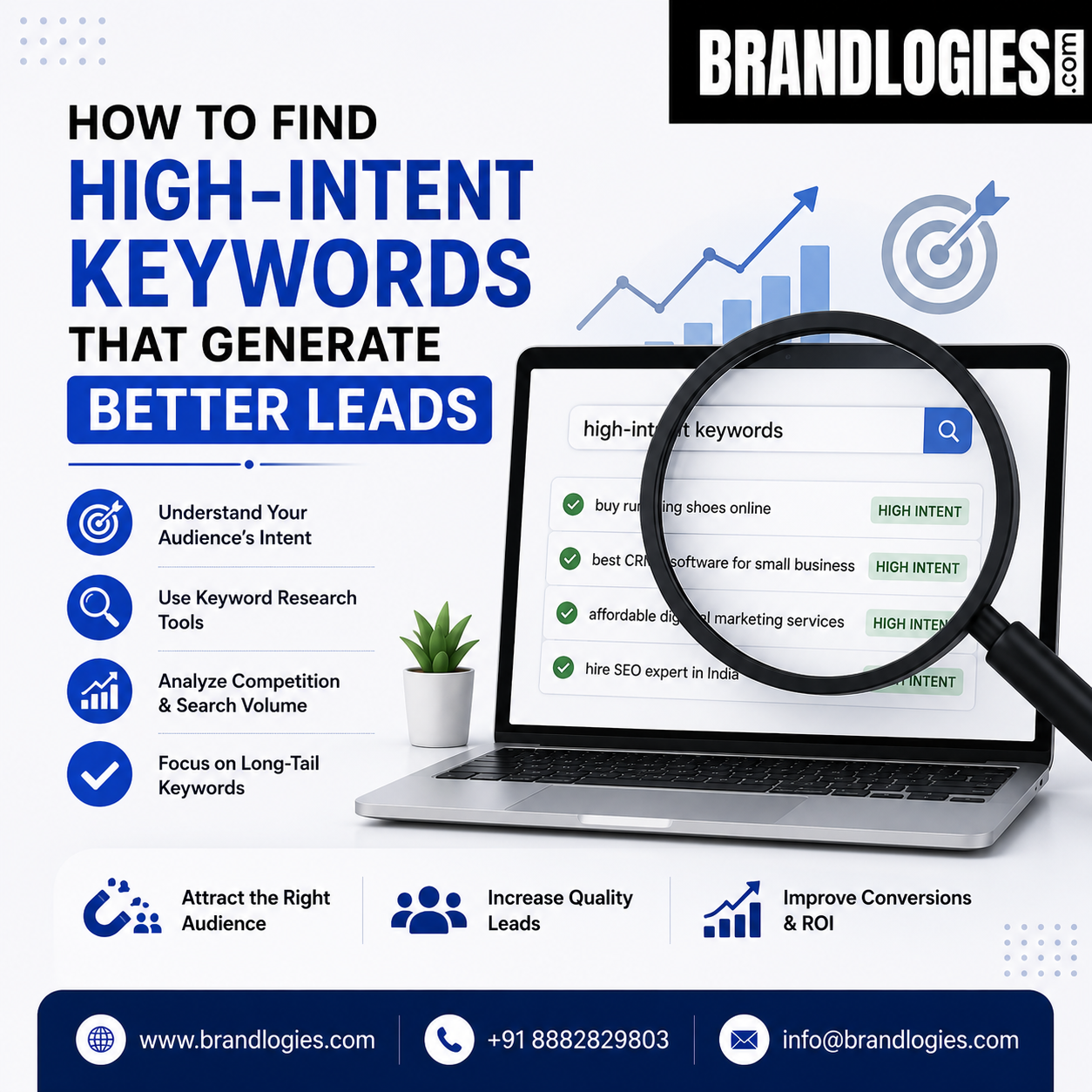
High-intent keywords are search terms used by people who are more likely to take action, such as requesting a quote, booking a service, making a purchase, or contacting a business. For companies focused on lead generation, finding these keywords can make SEO more valuable and improve the quality of incoming enquiries.
At Brandlogies, we focus on understanding what users actually want when they search instead of targeting keywords simply because they have high search volume.
What Are High-Intent Keywords?
High-intent keywords indicate that a person is closer to making a decision.
For example, someone searching for “what is SEO” is probably looking for information. However, someone searching for “SEO agency in Delhi” may already be comparing service providers.
Common high-intent phrases include:
- Buy
- Hire
- Get a quote
- Pricing
- Cost
- Near me
- Service
- Agency
- Company
- Consultant
- Book
- Contact
The exact intent depends on the industry and customer journey. A good SEO strategy identifies these differences before creating content.
1. Start With Your Customer’s Buying Journey
Before researching keywords, understand how customers move from awareness to decision-making.
A typical journey includes:
Awareness → Research → Comparison → Purchase
Informational keywords are usually stronger during the research stage, while commercial and transactional keywords can be more valuable closer to conversion.
For example, a person looking for a digital marketing agency might search:
“What is digital marketing?” → “best digital marketing services” → “digital marketing agency in Delhi” → “digital marketing agency pricing.”
The final searches show stronger commercial intent.
2. Look for Commercial Search Terms
One of the easiest ways to identify high-intent keywords is to look for words that indicate commercial interest.
Terms such as “best,” “top,” “services,” “pricing,” “cost,” “company,” and “agency” often indicate that users are evaluating available options.
However, do not assume every commercial keyword will generate leads. Check whether the search actually matches what your business offers.
A relevant keyword with moderate search volume can be much more valuable than a broad keyword attracting thousands of visitors who are unlikely to become customers.
3. Use Location-Based Keywords
Local businesses can find strong opportunities by adding location modifiers.
Examples include:
- SEO agency in Gurgaon
- Digital marketing company in Delhi
- Website development company in Noida
- Local SEO services in Mumbai
Location-based searches can be particularly valuable because the user is often looking for a provider available in a specific area.
Create location pages only when you can provide genuinely useful information about the service, area, and customer needs.
4. Study Competitor Keywords
Your competitors can reveal valuable keyword opportunities.
Look at the services they rank for, their landing pages, blog topics, page titles, and local pages. Instead of copying their strategy, identify gaps where your business can provide a better and more relevant answer.
For example, if competitors rank for a broad service keyword but have weak pricing information or poor FAQs, you may have an opportunity to create a more useful page.
5. Check the SERP Before Targeting a Keyword
Search the keyword yourself before deciding to target it.
Look at what appears in Google. Are the results mainly blog posts, service pages, product pages, local businesses, directories, or comparison websites?
This helps you understand the search intent.
If Google consistently shows service pages for a keyword, creating another purely informational article may not be the best approach.
6. Focus on Business-Relevant Keywords
Not every keyword with strong intent is worth targeting.
Ask three questions:
- Does this keyword relate directly to my service?
- Is the person searching likely to need what I offer?
- Can my website provide a strong answer or solution?
If the answer is yes to all three, the keyword is more likely to contribute to qualified leads.
At Brandlogies, keyword research should connect search behavior with actual business goals. The objective is not simply to increase rankings but to attract people who have a genuine reason to contact the business.
7. Create Pages That Match Search Intent
Once you identify valuable keywords, create content that satisfies the reason behind the search.
A service keyword should generally lead to a strong service page. A comparison keyword may require a detailed comparison article. A location-based query may need a useful local landing page.
Include clear information about:
- Services
- Benefits
- Pricing factors
- Process
- Experience
- FAQs
- Service areas
- Contact options
Make it easy for visitors to take the next step.
Why High-Intent Keywords Generate Better Leads
High-intent keywords help businesses reach users who are already looking for a solution.
Instead of measuring SEO success only through impressions and traffic, businesses can also evaluate:
- Qualified enquiries
- Form submissions
- Phone calls
- Consultation requests
- Sales
- Conversion rate
- Cost per lead
This creates a stronger connection between SEO activity and business results.
How Brandlogies Can Help
Finding profitable keywords requires more than using a keyword research tool. It involves understanding customers, competitors, search intent, locations, SERPs, and conversion opportunities.
Brandlogies can help businesses develop keyword strategies focused on attracting relevant visitors and generating better-quality leads. From keyword research and content planning to on-page SEO and conversion-focused landing pages, every part of the strategy should support a clear business objective.
Final Thoughts
The best SEO keyword is not always the one with the highest search volume. A smaller keyword used by someone ready to hire, buy, book, or request a quote can deliver far greater business value.
By understanding search intent, studying SERPs, analyzing competitors, using relevant commercial terms, and creating pages that match customer needs, businesses can turn SEO traffic into meaningful opportunities.
Brandlogies helps businesses move beyond traffic-focused SEO and build strategies designed around visibility, relevance, and lead generation.
FAQs
1. What are high-intent keywords?
High-intent keywords are search terms that indicate a strong possibility of taking action, such as purchasing a product, hiring a service, requesting a quote, or contacting a business.
2. How do I identify high-intent keywords?
Look for commercial and transactional terms, analyze search results, study competitor keywords, and check whether the searcher’s needs closely match your products or services.
3. Are high-volume keywords always better?
No. High-volume keywords can bring significant traffic but may have weak conversion potential. A lower-volume keyword with strong commercial intent can generate more qualified leads.
4. Should I use location-based keywords?
Yes, when your business serves specific geographic areas. Location-based keywords can help connect your services with customers searching for providers in their area.
5. Can Brandlogies help with high-intent keyword research?
Yes. Brandlogies can develop keyword and SEO strategies focused on relevant search intent, stronger visibility, qualified traffic, and better lead-generation opportunities.
Read Also – [2026] Google Keyword Planner Update 2026 – Forecast Views