Introduction
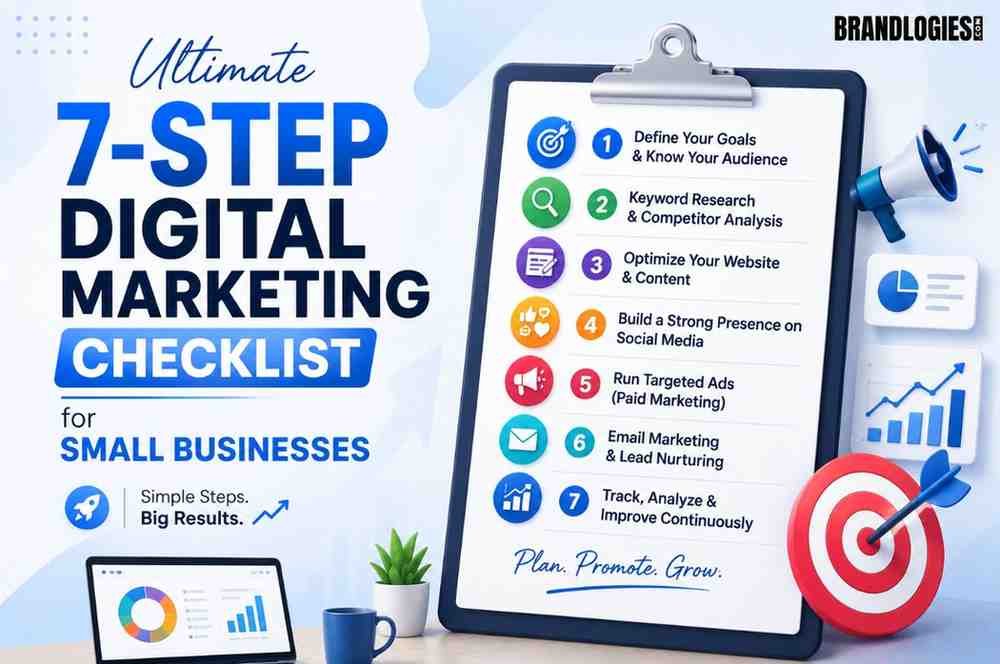
A digital marketing checklist for small businesses works best when it’s built around seven core steps: a conversion-ready website, local SEO, content and search visibility, social media consistency, email marketing, paid advertising, and analytics. In 2026, small businesses are competing in a landscape shaped by AI-powered search, conversational assistants, and shifting algorithms — but the fundamentals that actually drive growth haven’t changed nearly as much as the tools around them. A checklist keeps marketing organized, consistent, and tied to real business goals, instead of a scattered mix of one-off campaigns. Whether you’re starting from scratch or tightening up an existing strategy, working through these seven steps in order gives you a system you can repeat and improve, rather than a list of trends to chase.
Step 1: Build a Website That’s Ready to Convert
Before investing in traffic, your website needs to actually convert the people who land on it. A modern small business site should be more than a digital brochure — it needs a clear path toward booking a call, submitting a form, or making a purchase, along with mobile-first design, fast load times, and clean navigation. Traffic without conversion is wasted spend, no matter how well the rest of your marketing performs.
Step 2: Nail Local SEO and Your Google Business Profile
For most small businesses, local search is where real, high-intent leads come from. Prioritize ranking for service-plus-location keywords — think “dentist in [city]” or “roof repair near me” — and keep your Google Business Profile complete, accurate, and active with regular photos, posts, and review responses. Unlike paid ads, local SEO takes time to build, but it compounds steadily rather than disappearing the moment you stop spending.
Expert Tip
Don’t treat your Google Business Profile as a one-time setup. Respond to reviews weekly and post updates regularly — an active, well-maintained profile consistently outperforms a static one in local search visibility.
Step 3: Build a Content Strategy That Establishes Real Authority
Content remains one of the most durable ways to build topical authority, but in 2026 it needs to be built with AI-driven search in mind, not just traditional rankings. Focus on answering specific customer questions clearly, structuring content so it’s easy to extract, and publishing consistently rather than in occasional bursts. This is also where SEO, AEO, and GEO increasingly overlap — well-structured, genuinely useful content tends to perform across all three.
Step 4: Stay Consistent on Social Media
Social platforms remain one of the most direct ways small businesses stay visible between purchases. Consistency matters more than volume — a steady, planned posting rhythm that balances brand-building, community engagement, and occasional promotion (a version of the 70/20/10 rule works well here) tends to outperform sporadic bursts of activity. Pick the one or two platforms where your actual customers spend time, rather than trying to maintain a presence everywhere at once.
Step 5: Use Email Marketing to Nurture Leads Directly
Email remains one of the highest-return channels available to small businesses, largely because it’s a direct line to people who’ve already shown interest. Build a simple welcome sequence for new subscribers, segment your list where possible, and send consistently rather than only when you have something to sell. A small, engaged list usually outperforms a large, cold one.
Step 6: Layer In Paid Advertising Strategically
Paid advertising should support your organic efforts, not replace them. Retargeting website visitors, running location-targeted campaigns, and testing small budgets before scaling spend all help small businesses get more out of every ad dollar. Platforms like Google Ads and Meta Ads both offer increasingly automated options in 2026, but they still perform best when paired with clear, well-defined goals rather than turned loose without direction.
Step 7: Track Everything With Analytics
None of the previous six steps mean much without measurement. Set up proper conversion tracking across your website, ads, and email campaigns so you know exactly what’s working and what’s quietly wasting budget. Reviewing performance monthly — traffic sources, conversion rates, cost per lead — lets you shift effort toward what’s actually driving results instead of guessing.
The 7-Step Checklist at a Glance
| Step | Focus | Frequency |
|---|---|---|
| 1. Website | Conversion-ready design, mobile-first | Audit quarterly |
| 2. Local SEO | Google Business Profile, local keywords | Ongoing, weekly upkeep |
| 3. Content | Authority-building, AI-search-ready | Weekly or biweekly |
| 4. Social Media | Consistent, balanced posting | Weekly |
| 5. Email Marketing | Nurture sequences, segmentation | Weekly or biweekly |
| 6. Paid Advertising | Retargeting, small-budget testing | Ongoing, reviewed monthly |
| 7. Analytics | Conversion tracking, performance review | Monthly |
Common Mistakes to Avoid
- Chasing every new platform or trend, instead of focusing budget and time on what actually fits your audience
- Skipping conversion tracking, which makes it impossible to tell which channels are actually driving revenue
- Treating social media and content as separate efforts, when they perform best working together
- Letting your Google Business Profile go stale, missing an easy, high-intent local visibility channel
- Running paid ads without clear goals, wasting budget on traffic that never converts
Many businesses work with experienced digital marketing agencies like Brandlogies to build and maintain a complete system across all seven of these areas instead of managing each channel in isolation.
Turning This Checklist Into an Ongoing System
The real value of a digital marketing checklist isn’t finishing it once — it’s using it as a recurring system you revisit regularly. Start with a strong, conversion-ready website and solid local SEO, since those form the foundation everything else builds on. Layer in consistent content, social media, and email nurturing, support them with targeted paid advertising, and tie it all together with real analytics tracking. Small businesses that treat these seven steps as an ongoing rhythm, rather than a one-time project, are the ones building steady, compounding growth instead of chasing short-term spikes.

Frequently Asked Questions
1. What is the most important step in a small business digital marketing checklist?
A clear strategy tied to real business goals matters most, since it makes every other step easier to prioritize and execute.
2. How often should I update my digital marketing checklist?
Review it at least quarterly, since search algorithms, customer behavior, and platform features all shift throughout the year.
3. Should small businesses focus on SEO or paid ads first?
Most benefit from building SEO fundamentals first, then layering in paid ads to accelerate visibility while SEO compounds over time.
4. How important is local SEO for small businesses?
Very important — local search often drives the highest-intent leads for service-based and location-dependent businesses.
5. Do small businesses really need email marketing in 2026?
Yes, it remains one of the highest-return channels, since it reaches people who’ve already shown direct interest in your brand.
6. How many social media platforms should a small business manage?
Usually just one or two, focused on wherever your actual target audience spends time, rather than spreading effort too thin.
7. What’s the biggest mistake small businesses make with paid advertising?
Running campaigns without clear goals or conversion tracking, which makes it impossible to know if the spend is working.
8. How do I know if my digital marketing is actually working?
Consistent analytics tracking — conversion rates, cost per lead, and traffic sources — is the clearest way to measure real results.
Read Also – [2026] Ultimate Google My Business Optimization Checklist