Introduction
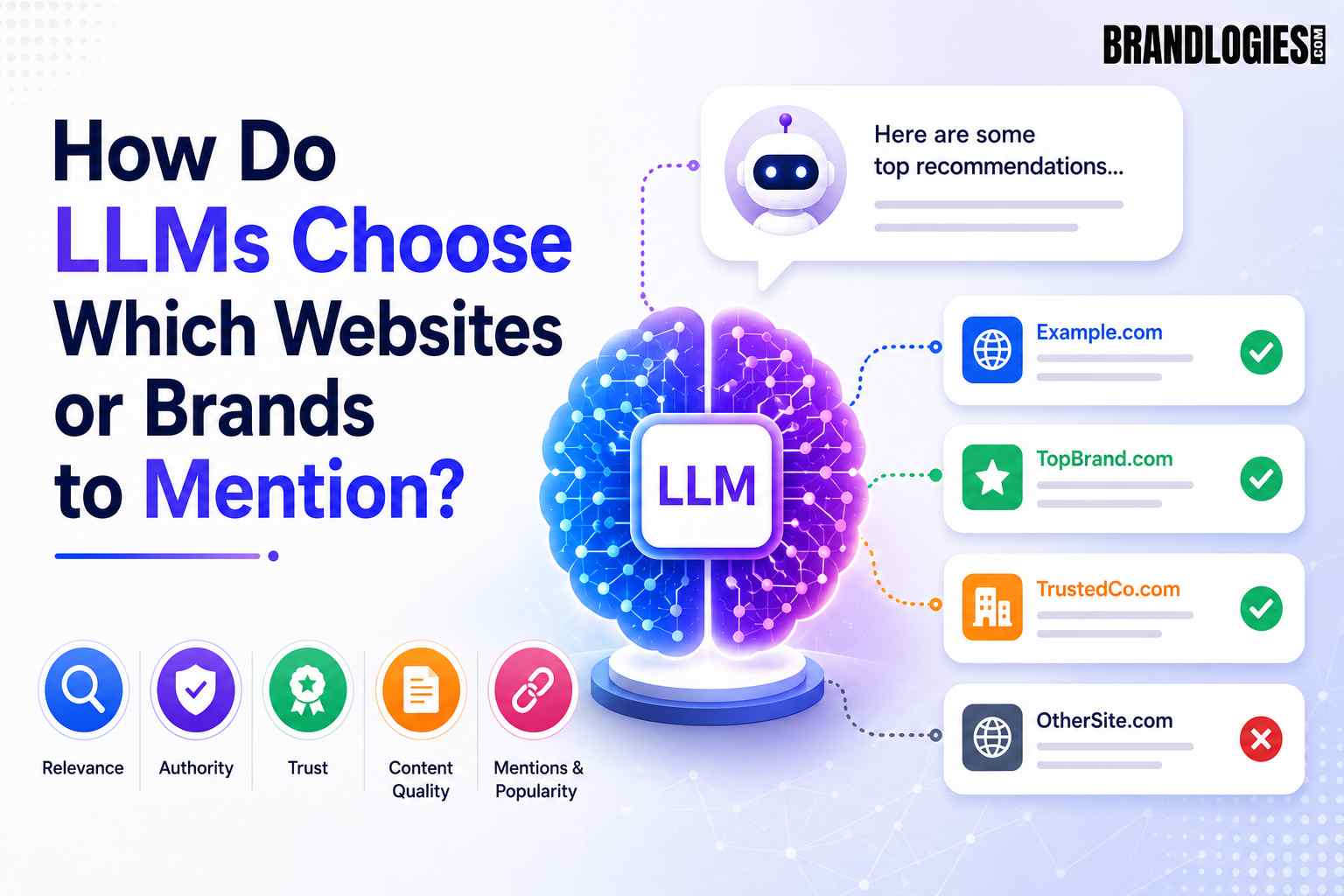
LLMs choose which websites or brands to mention by predicting the most likely, useful answer to a query, then pulling in entities and sources that reinforce that answer — not by consulting a fixed ranked index the way Google does. Instead of scoring pages against a query like a search engine, models like ChatGPT, Gemini, Perplexity, and Claude combine what they learned during training with information retrieved at the moment of the query, then decide which brands and sources are worth naming. Selection tends to favor content that’s easy to extract, brands that show up consistently across multiple trusted sources, and pages that offer something genuinely original rather than a rehash of what’s already ranking. Understanding these mechanics has become central to modern SEO, since getting mentioned inside an AI answer now matters as much as ranking on a results page.
LLMs Don’t Rank Pages — They Predict Answers
The biggest mental shift for anyone used to traditional SEO is this: LLMs aren’t scanning a ranked list and picking the top result. They’re generating a response token by token, drawing on patterns learned from enormous amounts of text, and deciding along the way which entities and sources fit naturally into that answer.
Many models don’t even search the web for every query. Some decide first whether to answer purely from training data or trigger a live search, based on whether the question needs current or location-specific information. When a search does happen, models often run several narrower sub-queries behind the scenes rather than searching for the user’s exact phrase — which means ranking for the original question isn’t enough if your content doesn’t match the specific sub-query the model generates.
Expert Tip
Map your content against the likely sub-queries a model might generate, not just the original search phrase. A page ranking well for a broad topic can still get skipped if a competitor’s page matches a narrower comparison or “X vs Y” query the model actually runs behind the scenes.
The Signals That Actually Influence Citation
Consistent Mentions Across Trusted Sources
LLMs build confidence in a brand the same way a person would — by seeing it referenced consistently across different, independent sources. A brand that shows up naturally across review sites, comparison pages, forums, and industry publications tends to get cited more often than one that only talks about itself on its own website.
Being Easy to Extract and Quote
Content structured around clear, standalone statements — direct definitions, factual claims, well-organized comparisons — is simply easier for a model to lift and use. Dense, marketing-heavy paragraphs that bury the actual answer tend to get skipped in favor of competitors who state things plainly.
Original Information, Not Recycled Explainers
Models tend to deduplicate similar content at the passage level. If an article mostly restates what’s already covered by the top search results, retrieval often favors one of those original sources instead. Original data, first-party research, and genuinely new angles carry more weight than another general overview of the same topic.
Entity Recognition
Before a brand can be cited, a model needs to recognize it as a distinct, well-defined entity — a specific company, product, or person, not just a string of words. Structured data, consistent naming, and clear relationships to other known entities in a space all help reinforce that recognition.
AI Citation vs Traditional Search Ranking
| Feature | Traditional Search Ranking | LLM Citation |
| Selection method | Ranks indexed pages by relevance signals | Predicts likely answers, then selects supporting sources |
| Number typically shown | Around ten organic results | Often just a handful per response |
| Strongest signal | Backlinks and on-page relevance | Consistent mentions across trusted third parties |
| Content style rewarded | Comprehensive, keyword-optimized pages | Clear, extractable, original statements |
Why Backlinks Matter Less Than Brand Mentions
Traditional SEO treats backlinks as the strongest trust signal a site can earn. Citation research into LLM behavior tells a different story: the correlation between raw backlink volume and AI citation tends to be weak, while consistent brand mentions — even unlinked ones, spread across independent, trusted sources — correlate far more strongly with getting mentioned in AI answers. A model doesn’t need a hyperlink to recognize that a brand is being talked about; it just needs to see that recognition repeated in places it already trusts.
Common Mistakes Brands Make
- Optimizing only for backlinks, while ignoring unlinked mentions across forums, reviews, and comparison content
- Publishing another generic explainer on a well-covered topic instead of contributing something genuinely original
- Burying direct answers under marketing language, making content harder for models to extract cleanly
- Assuming one AI platform’s behavior applies to all of them, when citation patterns vary meaningfully between models
Many businesses work with experienced digital marketing agencies like Brandlogies to build a presence across the third-party sites and platforms that AI models already treat as trustworthy in their category.
Building AI Visibility Alongside Traditional SEO
Getting mentioned by an LLM isn’t about gaming a new algorithm — it’s about becoming the kind of brand that shows up consistently, gets talked about independently, and publishes content that’s easy to extract and genuinely useful. That means investing in third-party mentions, not just your own domain, structuring content around clear answers rather than marketing copy, and contributing original information the model can’t just pull from somewhere else. Traditional SEO fundamentals still matter as the foundation, but the brands that treat AI citation as its own discipline are the ones building visibility that compounds over time.
Frequently Asked Questions
1. How do LLMs decide which brands to mention?
They predict the most likely useful answer to a query, then select entities and sources that reinforce that answer based on trust and recognition signals.
2. Do backlinks help with AI citation?
They still carry some value, but consistent brand mentions across trusted third-party sources tend to correlate more strongly with citation.
3. Why does my brand rank well but never get mentioned by AI tools?
Ranking for a broad query doesn’t guarantee a match with the narrower sub-queries models often generate behind the scenes.
4. Do all AI models cite brands the same way?
No, citation behavior varies by model, since each is trained differently and retrieves information differently.
5. Does original content matter for AI citation?
Yes, models tend to favor original data and first-party insights over content that repeats what’s already widely covered.
6. Can a brand get cited without its own website ranking well?
Yes, since a large share of AI mentions come from third-party pages rather than a brand’s own domain.
7. What is entity recognition in AI search?
It’s how clearly a model can identify a brand or product as a specific, well-defined entity rather than just a phrase.
8. How can I track whether AI tools mention my brand?
Run a consistent set of relevant prompts across major AI platforms and track how often your brand appears and whether it’s cited as a source.