Introduction
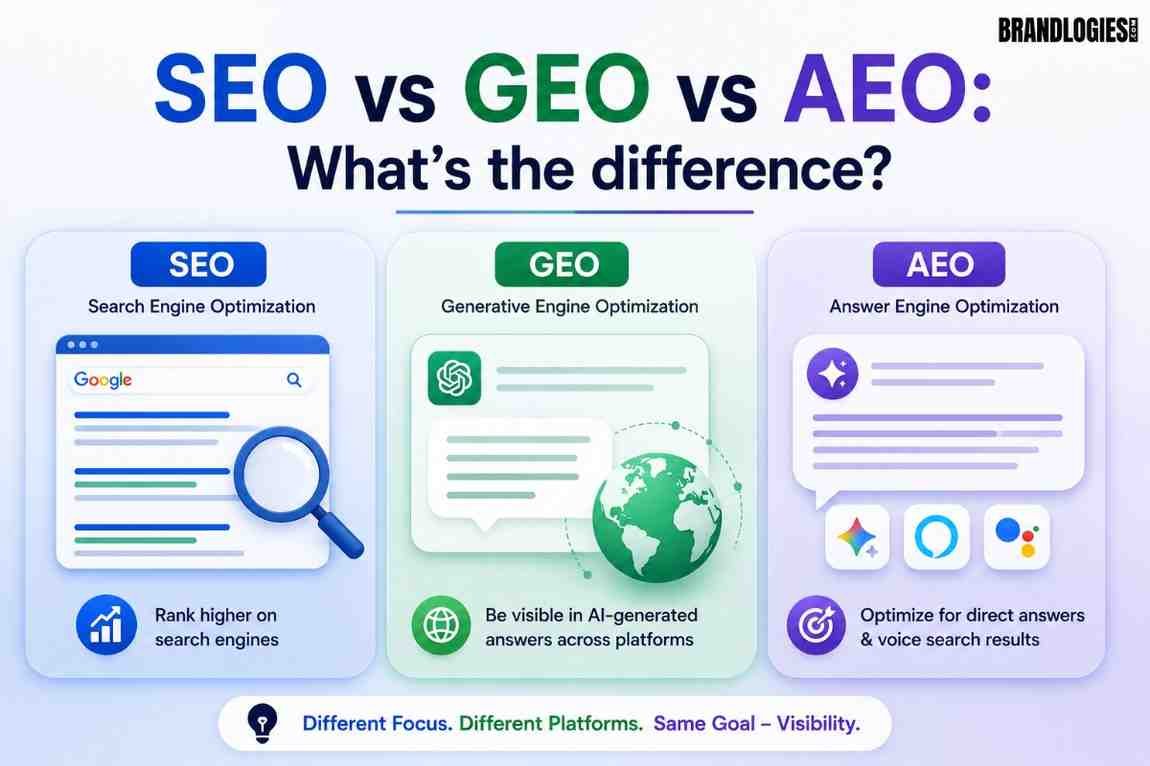
SEO vs GEO vs AEO comes down to three different jobs within the same broader goal of visibility: SEO gets you ranked in traditional search results, AEO gets you selected as the direct answer in featured snippets and AI Overviews, and GEO gets you cited as a source inside AI-generated responses from tools like ChatGPT, Perplexity, and Gemini. These aren’t competing strategies fighting for the same budget — they’re three layers of the same overall discipline, and in 2026 most businesses need all three working together rather than picking one. SEO remains the foundation everything else builds on; AI systems still favor pages that are technically sound, crawlable, and authoritative. AEO and GEO simply extend that foundation into new surfaces users increasingly rely on instead of clicking through ten blue links.
SEO: The Foundation
Search Engine Optimization is the original discipline, focused on improving a website’s visibility in classic organic search results — mainly Google, but also Bing and other traditional engines. It’s built on technical site health, keyword-optimized content, internal linking, page speed, and earning authoritative backlinks over time. SEO hasn’t died in 2026; it’s simply become the prerequisite layer underneath AEO and GEO. AI engines still tend to cite pages that are technically solid and already trusted in traditional search, which means neglecting SEO fundamentals undercuts your odds in the other two disciplines as well.
AEO: Becoming the Direct Answer
Answer Engine Optimization is the practice of structuring content so it gets selected as a direct answer, rather than just one link among many. This covers featured snippets, Google AI Overviews, People Also Ask boxes, voice assistant responses, and knowledge panels. AEO builds directly on SEO fundamentals — if a page isn’t crawlable, indexed, and considered relevant, answer engines won’t surface it no matter how well-formatted the content is. What sets AEO content apart is structure: clear, standalone answers near the top of a page, direct definitions, and content organized around specific questions rather than a broad topic overview.
GEO: Becoming the Cited Source
Generative Engine Optimization is the newest of the three, focused on how large language models decide which sources to reference or cite when generating a synthesized answer. When someone asks ChatGPT, Perplexity, or Gemini a question, that system pulls from across the web to construct a response — GEO is about earning a place inside that response as a trusted, cited source. Unlike AEO, GEO often doesn’t drive direct clicks the way traditional search does; a user reading an AI-generated answer may see your brand mentioned without ever visiting your site. That makes GEO less about immediate traffic and more about brand visibility and authority within a context millions of people now use before ever running a traditional search.
Expert Tip
Don’t assume you need three completely separate content strategies. One well-structured piece — an answer-first opening, clear FAQ sections, original insight, and visible authorship — can perform across SEO, AEO, and GEO at the same time. The disciplines mostly diverge in measurement, not in the underlying content quality they reward.
SEO vs AEO vs GEO: Side-by-Side
| Dimension | SEO | AEO | GEO |
|---|---|---|---|
| Goal | Rank in search results | Become the direct answer | Get cited inside AI-generated answers |
| Primary surfaces | Google, Bing organic results | Featured snippets, AI Overviews, voice | ChatGPT, Perplexity, Gemini, Copilot |
| Success metric | Rankings, organic traffic | Snippet and AI Overview appearances | Citation frequency, brand mentions |
| Core signals | Backlinks, technical health, relevance | Structured answers, schema markup | Entity authority, original insight, third-party mentions |
| Drives direct clicks? | Yes | Sometimes | Rarely |
How the Three Layers Interact
These disciplines share most of their foundation and diverge mainly at the edges. Strong technical SEO and authoritative content underpin both AEO and GEO — without it, answer engines and AI models have little reason to trust or surface a page in the first place. AEO adds a structural layer on top, organizing that trusted content into direct, extractable answers. GEO adds an off-site layer beyond that, built around entity recognition and consistent brand mentions across sources an AI model already treats as credible. Rather than three separate projects, the strongest 2026 strategies treat this as one operation: one content plan, one measurement dashboard, one team accountable for all three.
How to Measure Each One
- For SEO, track rankings, organic traffic, and backlink growth through tools like Google Search Console and standard rank trackers.
- For AEO, monitor featured snippet ownership, AI Overview appearances, and People Also Ask visibility for your priority queries.
- For GEO, check referral traffic from AI platforms in your analytics, and manually test priority queries across ChatGPT, Perplexity, and Gemini to see whether and how your brand gets cited.
Common Mistakes to Avoid
- Treating SEO, AEO, and GEO as identical, when each requires slightly different tactics and produces different deliverables
- Ignoring GEO entirely while competitors quietly build authority inside AI-generated answers
- Over-investing in answer engines at the expense of traditional search traffic, which still drives the majority of clicks for many industries
- Failing to track AI citations alongside conventional analytics, missing a growing share of how your audience actually discovers you
- Assuming a small brand can’t compete in GEO, when focused expertise and consistent authority signals can help niche brands gain traction quickly
Many businesses work with experienced digital marketing agencies like Brandlogies to run SEO, AEO, and GEO as one integrated content strategy rather than three separate efforts.
Running All Three as One Strategy
The debate over which discipline matters most misses the point — SEO, AEO, and GEO are asking different questions about the same content, not competing for the same budget. Start with strong SEO fundamentals, since nothing else works without them. Layer in AEO by structuring content around clear, direct answers and proper schema. Then build GEO by earning consistent, trusted mentions across the sources AI models already rely on. The businesses seeing real visibility gains in 2026 aren’t debating which acronym wins — they’re building content that ranks, gets featured, and gets cited, all from the same foundation.

Frequently Asked Questions
1. What’s the simplest way to describe the difference between SEO, AEO, and GEO?
SEO gets you ranked, AEO gets you featured as the direct answer, and GEO gets you cited inside AI-generated responses.
2. Is SEO dead because of AEO and GEO?
No, SEO is the foundation both AEO and GEO are built on, and neglecting it undermines the other two.
3. Do I need separate content for SEO, AEO, and GEO?
Mostly no — one well-structured piece with clear answers, schema, and original insight can perform across all three.
4. Does GEO drive website traffic the way SEO does?
Not usually, since users often read an AI-generated answer without clicking through to the cited source.
5. How do I know if AI tools are citing my content?
Check referral traffic from AI platforms in your analytics, and manually test your priority queries across major AI engines.
6. Can small brands compete in GEO against larger competitors?
Yes, focused expertise and consistent authority signals can help niche brands gain traction in AI citations relatively quickly.
7. What’s the main technical difference between AEO and GEO content?
AEO leans heavily on structured data and direct-answer formatting, while GEO depends more on entity authority and off-site mentions.
8. Should I prioritize one of the three over the others?
Most businesses benefit from addressing all three proportionally, based on where their specific audience actually discovers information.
Read Also – AI SEO vs Traditional SEO: What’s Changed in 2026?