Introduction
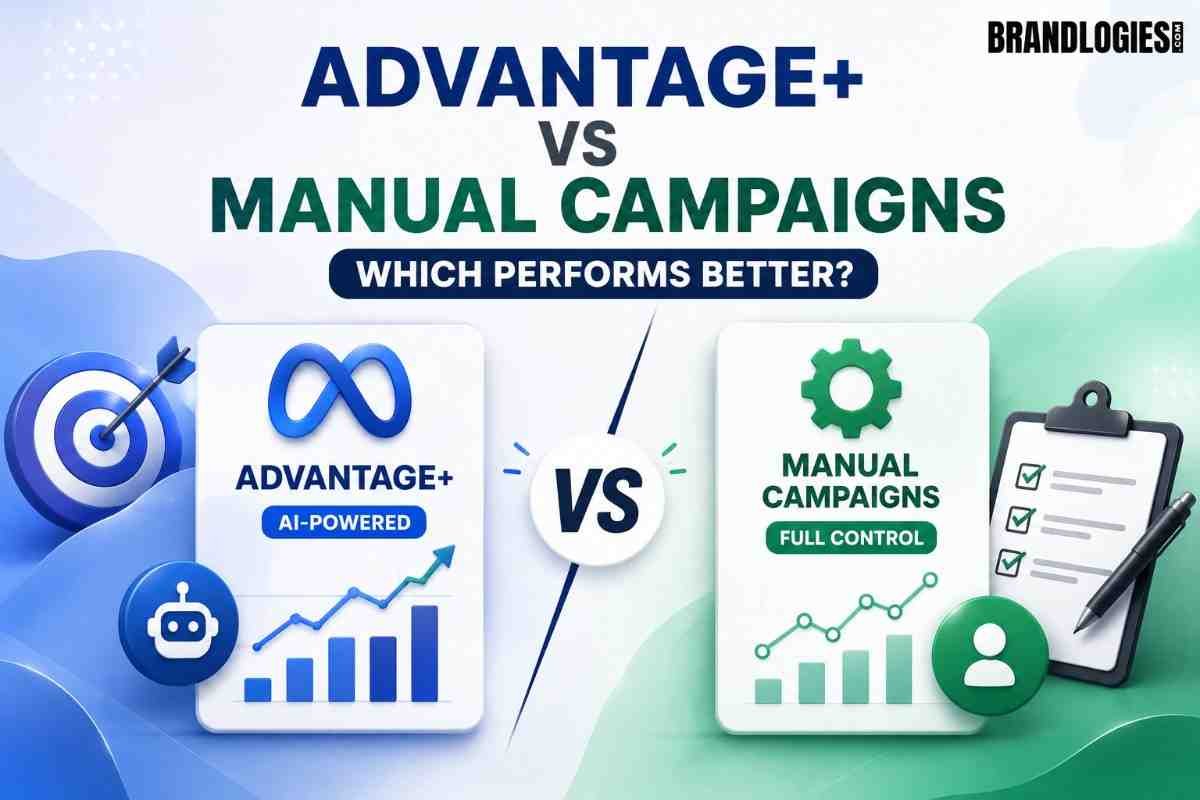
Advantage+ vs manual campaigns is less about which one wins outright and more about which one fits your budget, data volume, and audience complexity. Advantage+ automates targeting, placement, and creative optimization using Meta’s AI, consolidating what used to be five or ten manual ad sets into a single, streamlined campaign that requires mainly creative assets and budget. Manual campaigns keep full advertiser control over audience targeting, placements, bidding, and budget allocation at the ad set level. On aggregate, many advertisers report stronger performance from Advantage+ once a campaign has real conversion volume and diverse creative behind it, while manual campaigns still tend to win for precise targeting, creative testing, new product launches, and complex B2B or high-ticket audiences that broad automation struggles to qualify. Neither approach is universally superior the decision comes down to matching the tool to your specific situation.
What Is Advantage+?
Advantage+ is Meta’s AI-driven campaign structure, available across Shopping, App, and other objective-based formats. Instead of manually selecting interests, placements, and bid strategies, you define an objective and provide strong creative assets, and Meta’s machine learning handles delivery based on real-time behavioral signals like browsing activity, engagement patterns, and purchase history. The system continuously tests combinations of creative, placement, and audience, shifting budget toward whichever combination performs best. This often means Advantage+ campaigns feel inconsistent in the first few days before stabilizing once the algorithm gathers enough data.
What Are Manual Campaigns?
Manual campaigns give advertisers direct control over every structural element audience definition, placement selection, bid strategy, and budget allocation per ad set. This level of control makes manual campaigns particularly valuable for gathering clean audience insights, running controlled creative tests, and precisely excluding or including specific segments that broad automation can’t reliably distinguish between.
Expert Tip
Don’t touch a newly launched Advantage+ campaign during its early learning period. Adjusting budget, creative, or settings while the algorithm is still gathering signal effectively resets its learning process, which can quietly cost you performance during the exact window it needs to stabilize.
Advantage+ vs Manual Campaigns: Side-by-Side
| Feature | Advantage+ | Manual Campaigns |
|---|---|---|
| Setup complexity | Low — one consolidated campaign | Higher — multiple ad sets and settings |
| Targeting control | Automated, based on behavioral signals | Full manual control over audience |
| Best for | Scaling with strong conversion data | Precision targeting, testing, niche audiences |
| Data requirement | Needs meaningful weekly conversion volume | Works with lower or less consistent volume |
| Learning period | Often shorter with enough signal | Can vary widely by ad set structure |
| Ideal budget range | Performs best at higher daily spend | Can perform well at lower daily spend |
When Advantage+ Tends to Win
Advantage+ tends to perform best for ecommerce and broadly appealing consumer products with a mature, established conversion history. Businesses running consistent weekly conversion volume, with diverse creative assets ready to feed the algorithm, are generally well positioned to benefit from Advantage+’s automatic audience expansion and dynamic creative testing. Higher daily budgets tend to accelerate how quickly the algorithm reaches a stable, optimized state as well.
When Manual Campaigns Still Make Sense
Manual campaigns remain the stronger choice in several common situations:
- New product launches with no existing conversion history for the algorithm to learn from
- B2B and high-ticket audiences, where broad automated targeting often struggles to reliably qualify decision-makers
- Creative and audience testing, since manual structure makes it easier to isolate what’s actually driving performance
- Niche or narrowly defined audiences, where style, professional criteria, or other specific qualifiers matter more than broad behavioral signals
Why Many Advertisers Use Both
Rather than treating this as an either-or decision, many marketers now run manual campaigns to gather audience insights and test creative, then feed those learnings into Advantage+ campaigns to scale what’s already proven to work. For high-ticket or complex service businesses, a hybrid approach often works especially well — leaning on Advantage+ for broad, efficient discovery of new prospects, while using manual campaigns to maintain strict control over lead quality and handle bottom-of-funnel retargeting.
Common Mistakes to Avoid
- Launching Advantage+ with thin or inconsistent conversion data, which gives the algorithm too little signal to optimize effectively
- Adjusting campaign settings too early, resetting the learning phase before it has a chance to stabilize
- Assuming manual campaigns are obsolete, when they remain essential for testing, launches, and tightly qualified audiences
- Applying the same campaign type across every product category, when performance between Advantage+ and manual can vary meaningfully depending on the product and audience
- Ignoring budget thresholds, since Advantage+ campaigns generally need a meaningful daily spend to reach strong, stable performance
Many businesses work with experienced digital marketing agencies like Brandlogies to structure a hybrid Meta Ads strategy that uses manual and Advantage+ campaigns for what each does best.
Choosing the Right Structure for Your Business
There’s no single winner between Advantage+ and manual campaigns the right choice depends on how much conversion data you have, how complex your target audience is, and how much control you’re willing to trade for scale. Businesses with mature conversion volume and broadly appealing products tend to see stronger results letting Advantage+ handle delivery, while those launching new products, targeting niche or high-ticket audiences, or still gathering audience insight are usually better served keeping manual control. The advertisers seeing the strongest results in 2026 aren’t picking one permanently — they’re using each campaign type deliberately, based on what stage their product and data are actually in.
Frequently Asked Questions
1. Does Advantage+ always outperform manual campaigns?
No, performance depends heavily on conversion data volume, product category, and audience complexity — neither approach wins universally.
2. How much conversion data do I need before trying Advantage+?
There’s no fixed number, but Advantage+ generally performs best with consistent, meaningful weekly conversion volume behind it.
3. Are manual campaigns still worth using in 2026?
Yes, especially for new product launches, creative testing, and niche or high-ticket audiences that broad automation struggles to qualify.
4. Can I run Advantage+ and manual campaigns together?
Yes, many advertisers use manual campaigns for testing and insight, then scale proven strategies through Advantage+.
5. Why does Advantage+ perform inconsistently at first?
The algorithm needs time to gather behavioral signals and test creative and placement combinations before stabilizing.
6. Is Advantage+ better for ecommerce or B2B businesses?
It tends to perform best for ecommerce and broadly appealing consumer products; B2B often still benefits from manual targeting precision.
7. Should I adjust an Advantage+ campaign during its learning phase?
Generally no, since frequent changes during this period can reset the algorithm’s learning progress and hurt performance.
8. What budget level works best for Advantage+ campaigns?
Advantage+ tends to perform better at higher daily budgets, while manual campaigns can perform well even at lower daily spend levels.