Introduction: You’re Ranking #1, So Why Aren’t You Getting More Customers?
Ranking #1 on Google sounds like the perfect SEO success story. Your website is at the top, your target keyword is performing well, and your SEO reports look positive.
But then you check your enquiries—and nothing seems to change.
Traffic may be inconsistent. Click-through rates may be low. Visitors may leave without taking action. Your competitors may still be getting more leads even when your website ranks below them.
So, what is going wrong?
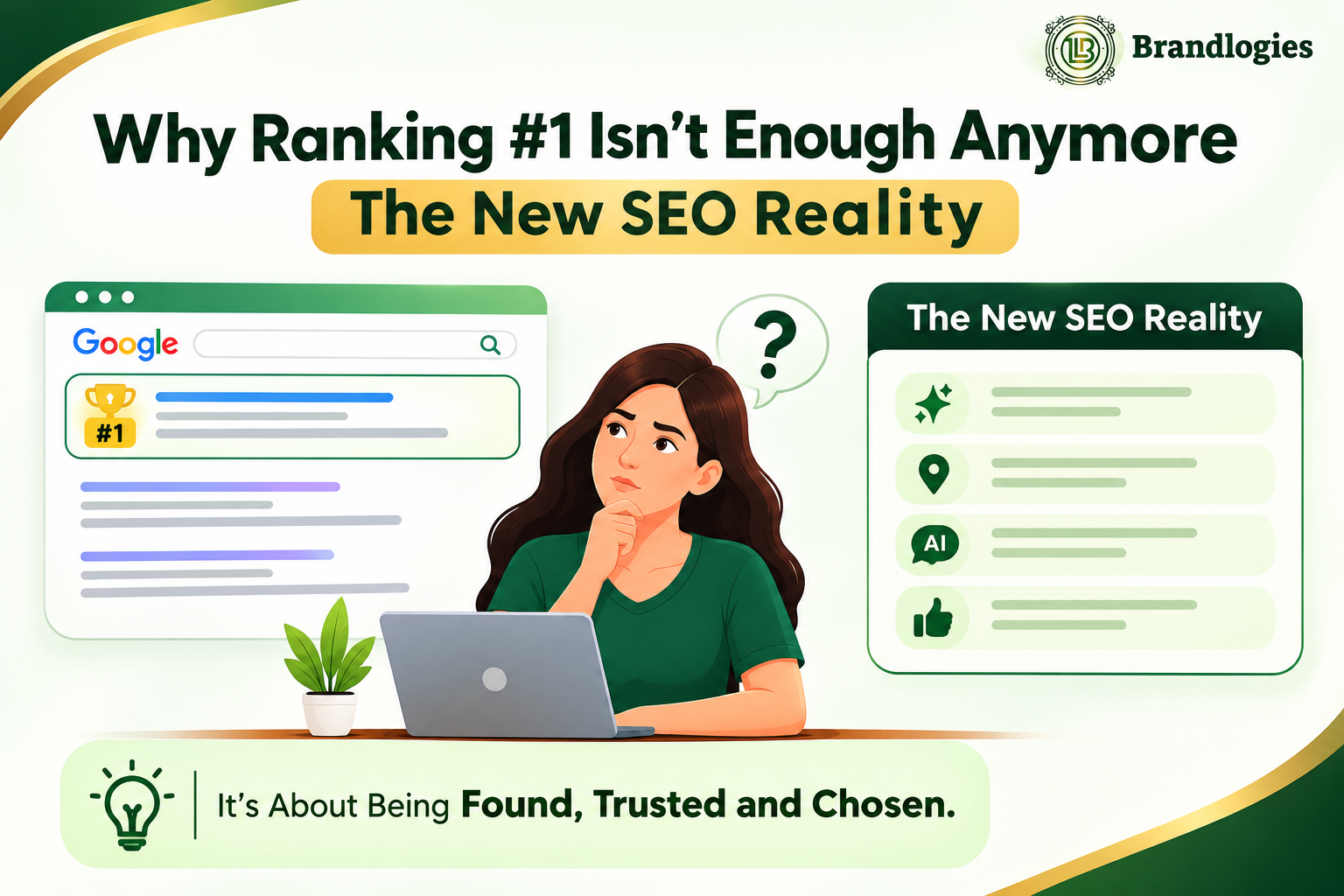
The problem is that modern SEO is no longer just about achieving the first position on Google. Search behaviour has changed, and users now interact with search results through AI answers, featured snippets, Google Maps, People Also Ask, reviews, social media, and other platforms.
This means a business can rank #1 and still lose customers.
At Brandlogies, we believe the real SEO question is not “Are you ranking first?” but “Are you being found, trusted, and chosen?”
Your #1 Ranking Is Getting Impressions but Not Clicks
One of the most common problems businesses face is a low click-through rate despite strong rankings.
Why?
Search results have become more competitive.
A user may see advertisements, featured snippets, images, videos, local listings, FAQs, and AI-generated answers before reaching the traditional organic result.
Even if your website appears first, another result may have a more compelling title or answer the user’s question immediately.
What can you do?
Instead of focusing only on rankings, improve the entire search result experience.
Use:
- Clear and relevant meta titles
- Compelling meta descriptions
- Search-intent-focused content
- FAQ sections
- Structured headings
- Strong brand messaging
- Accurate and useful information
The goal is to make users think, “This is exactly what I was looking for.”
Your Traffic Is High, but Leads Are Low
Getting visitors is not the same as getting customers.
A website can attract thousands of visitors but generate very few enquiries if the content does not match the visitor’s intent.
For example, someone searching for “SEO tips” may only want information. Someone searching for “SEO agency for small business” is much closer to making a buying decision.
If your website treats both users the same way, your conversion rate can suffer.
The solution: Match content with search intent
Create different content for different stages of the customer journey:
Informational:
“What is SEO?”
Commercial:
“How much does SEO cost?”
Transactional:
“Best SEO agency for small businesses”
Local:
“SEO agency in Delhi”
When your content answers the right question at the right stage, SEO can generate more meaningful leads.
AI Search Is Taking Attention Away From Traditional Results
Search is changing because users increasingly expect direct answers.
Instead of clicking through several websites, people may ask an AI-powered search engine a question and receive a summarized response.
This creates a new challenge for businesses.
Your website may rank well but still receive fewer clicks if users get the information they need directly from an AI-generated answer.
This is where AEO (Answer Engine Optimization) and GEO (Generative Engine Optimization) become important.
Your content should be structured around clear questions and useful answers so search engines and AI systems can understand your expertise and context.
For example, instead of hiding the answer deep inside a 1,500-word article, provide a concise answer under a relevant heading and then explain the topic in detail.
Your Competitor Looks More Trustworthy Than You
SEO is also about perception.
Imagine two companies offering similar services. One has a high-ranking website but very few reviews, outdated content, and limited information.
The other appears across Google, Maps, social media, industry websites, and review platforms with useful content and consistent branding.
Which one would you trust?
Most customers will choose the business that appears more credible.
This is why brand authority matters.
Your SEO strategy should support your wider digital presence through:
- Helpful content
- Customer reviews
- Local listings
- Industry mentions
- Case studies
- Authoritative backlinks
- Consistent business information
- Active brand communication
A strong brand can make your search visibility more valuable.
Your Website Ranks Well but Doesn’t Convert
Another common issue is poor website experience.
A visitor clicks your #1 result, lands on the website, and immediately faces slow loading, confusing navigation, generic content, or no obvious next step.
The ranking did its job.
The website didn’t.
Your pages should make it easy for visitors to understand:
What do you offer?
Why should they choose you?
What should they do next?
Clear CTAs, simple navigation, mobile-friendly design, fast loading speeds, trust signals, and relevant content can help turn search traffic into enquiries.
You Are Optimizing for Keywords Instead of People
Keyword density used to dominate SEO conversations.
Today, simply repeating a keyword is not enough.
Search engines are much better at understanding topics, relationships, context, and intent.
This means content should naturally use related terms and answer the broader questions around a topic.
For example, a page targeting “digital marketing agency” should not repeatedly use the exact phrase. It should also explain services, processes, industries served, locations, results, strategies, and frequently asked questions.
Write for people first and optimize for search engines second.
How Brandlogies Approaches the New SEO Reality
At Brandlogies, SEO is treated as more than a ranking exercise.
The focus is on building a complete search presence that connects:
SEO + AEO + GEO + Local SEO + Content + UX + Conversion
This approach helps businesses move from simply appearing in search results to becoming a credible answer for potential customers.
The objective is not to chase every algorithm update. It is to build a website and brand that remain useful as search behaviour continues to evolve.
What Should You Measure Instead of Rankings?
Rankings are still worth monitoring, but they should not be your only KPI.
Look at:
- Organic traffic quality
- Click-through rate
- Leads and enquiries
- Conversion rate
- Search visibility
- Featured snippet presence
- Local search visibility
- Brand searches
- Engagement
- Returning visitors
- Qualified traffic
These metrics provide a clearer picture of whether SEO is actually helping your business grow.
Frequently Asked Questions
1. Is ranking #1 still important for SEO?
Yes. Ranking #1 can provide strong visibility and credibility, but it does not guarantee clicks, leads, or sales. Modern SEO requires businesses to optimize the complete search experience.
2. Why am I ranking #1 but getting very little traffic?
A low click-through rate, weak search intent alignment, competing ads, featured snippets, AI answers, or unattractive search-result messaging can reduce clicks even when you rank first.
3. What is AEO in SEO?
AEO stands for Answer Engine Optimization. It focuses on creating and structuring content so that search engines and answer engines can easily understand and provide your information when users ask questions.
4. What is GEO in digital marketing?
GEO, or Generative Engine Optimization, focuses on improving a brand’s visibility and relevance within AI-powered search and generative answer platforms.
5. Can SEO generate leads without ranking #1?
Absolutely. A highly relevant page ranking in the top results can generate better leads than a #1 page targeting the wrong search intent. Relevance and conversion potential matter alongside rankings.
6. How can I improve my website’s SEO performance?
Start by understanding search intent, improving technical SEO, creating helpful content, optimizing titles and descriptions, strengthening internal linking, improving page experience, building authority, and tracking conversions—not just rankings.
7. Is keyword density still important?
Keywords remain useful for communicating relevance, but excessive repetition can make content unnatural. Modern SEO focuses more on topic coverage, intent, context, usefulness, and overall content quality.
8. How can Brandlogies help with modern SEO?
Brandlogies can help businesses build a broader search strategy that combines SEO, content, local visibility, AEO, GEO, website optimization, and conversion-focused strategies.
Final Thoughts
The biggest SEO mistake businesses can make today is treating ranking #1 as the final destination.
A ranking is only an opportunity.
If users don’t click, trust, engage, or convert, that ranking has limited business value.
The new SEO reality is about being visible wherever your customers search, providing the answers they need, building trust before they contact you, and creating a website experience that encourages action.
Rank high. Get noticed. Build trust. Generate results.
That is what modern SEO should really be about—and that is the approach Brandlogies brings to businesses looking beyond rankings.
Read Also: Top SEO Trends Every Business Should Follow in 2026