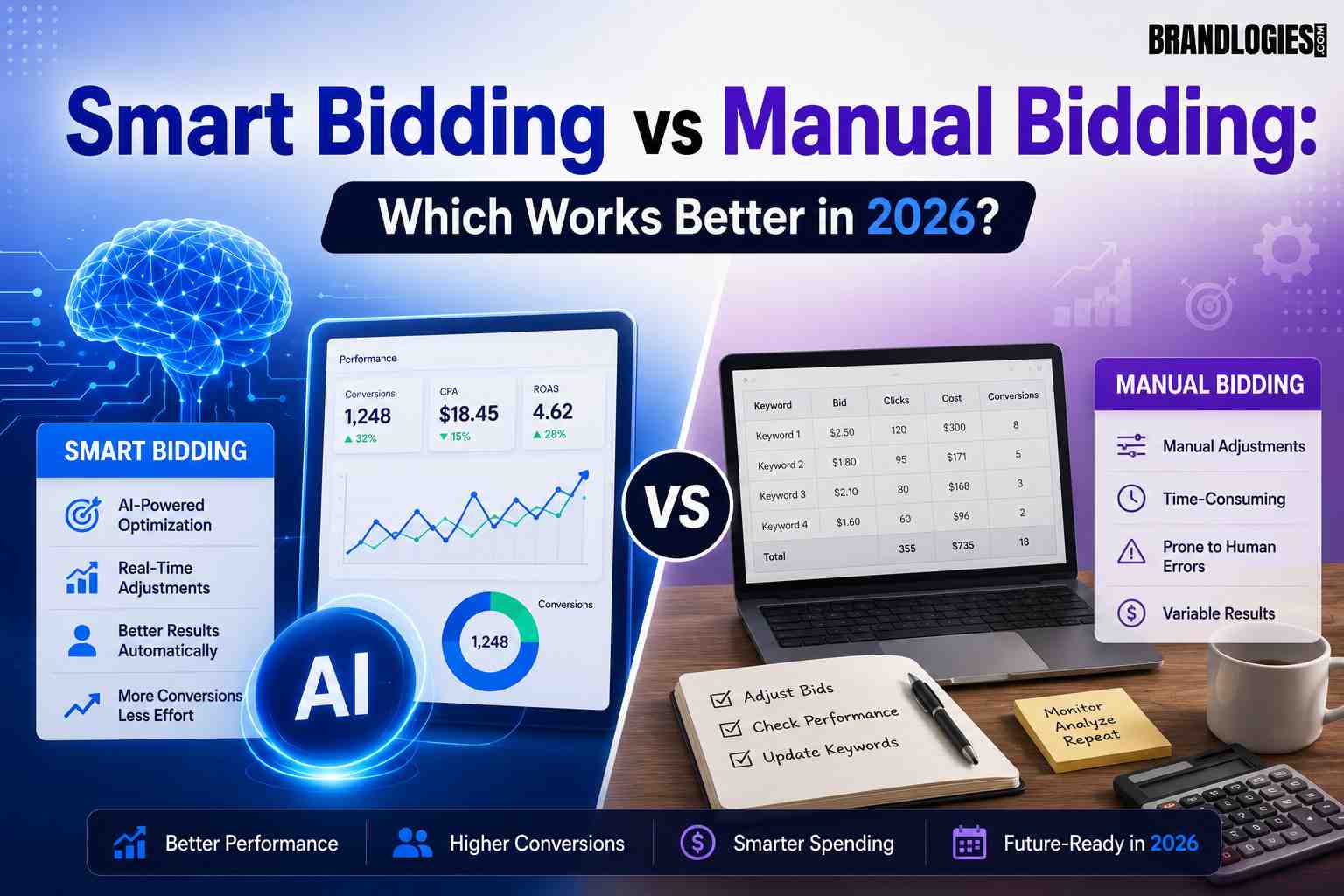
Smart Bidding vs manual bidding comes down to one core trade-off in 2026: automated control powered by Google’s machine learning versus direct, hands-on control over every keyword. Smart Bidding — which includes Target CPA, Target ROAS, Maximize Conversions, and Maximize Conversion Value — uses real-time signals like device, location, time of day, and conversion likelihood to set bids for every single auction. Manual bidding, by contrast, means setting a fixed maximum cost-per-click yourself and adjusting it based on performance data you review. For most accounts with steady conversion volume, Smart Bidding now outperforms manual bidding because it processes far more auction-time signals than a person realistically can. But manual bidding still has a real place — particularly for low-volume campaigns, tight budget control, and early-stage testing before enough conversion data exists.
What Is Smart Bidding?
Smart Bidding is Google’s suite of automated bidding strategies that use machine learning to optimize bids for conversions or conversion value in every auction. This is often called “auction-time bidding,” since the system evaluates each search individually rather than applying one flat bid across the board.
The four core Smart Bidding strategies are:
- Maximize Conversions — aims to get as many conversions as possible within your budget
- Target CPA — sets bids to hit a specific cost-per-acquisition goal
- Maximize Conversion Value — prioritizes higher-value conversions over volume
- Target ROAS — aims for a specific return on ad spend
Worth noting: Google renamed some of these strategies in 2026 — “Maximize conversions with a Target CPA” became simply “Target CPA,” and the equivalent ROAS strategy was renamed the same way. The underlying bidding behavior didn’t change, only the label.
What Is Manual Bidding?
Manual bidding, most commonly Manual CPC, lets you set the maximum amount you’re willing to pay per click at the keyword or ad group level. Google never exceeds that ceiling, giving you precise, predictable cost control. The trade-off is that manual bids can’t react to auction-time context — a bid stays the same whether someone is searching at 2 a.m. on mobile or during peak business hours on desktop.
Enhanced CPC, once a middle-ground option that nudged manual bids up or down based on conversion likelihood, has largely been phased out or absorbed into Smart Bidding strategies as Google continues shifting its platform toward full automation.
Expert Tip
Don’t switch to Smart Bidding before your conversion tracking is solid. If your tag is firing on the wrong events, the algorithm will optimize for the wrong outcome entirely — accurate tracking matters more than which strategy you choose.
Smart Bidding vs Manual Bidding: Side-by-Side
| Feature | Manual Bidding | Smart Bidding |
|---|---|---|
| Who sets the bid | You, per keyword or ad group | Google’s AI, per individual auction |
| Signals used | None beyond your own adjustments | Device, location, time, audience, and more |
| Best for | Low conversion volume, brand campaigns, testing | Accounts with steady, clean conversion data |
| Learning period | None | Typically 1–2 weeks after activation |
| Control level | High, but labor-intensive at scale | Lower granular control, higher automation |
When Manual Bidding Still Makes Sense
Manual bidding hasn’t disappeared, and it still fits a few specific situations well:
- New accounts with little or no conversion history, where the algorithm has nothing reliable to learn from
- Very low conversion volume, since Smart Bidding generally needs a meaningful number of monthly conversions to optimize effectively
- Regulated industries with strict cost-per-lead requirements that leave no room for a volatile learning period
- Tight, fixed budgets where predictable per-click costs matter more than scale
When Smart Bidding Wins
Once an account clears a reasonable volume of monthly conversions and has clean, accurate tracking in place, Smart Bidding consistently pulls ahead. It can evaluate thousands of contextual signal combinations per campaign simultaneously — something no person can realistically replicate by hand. Many newer campaign types, like Performance Max and Demand Gen, don’t offer manual bidding as an option at all, which reflects how central Smart Bidding has become to Google’s overall ad platform strategy.
Common Mistakes to Avoid
- Switching to Smart Bidding with unrealistic targets, which throttles reach before the algorithm has a chance to learn
- Adjusting bids or budgets during the learning phase, which resets the learning process and extends underperformance
- Staying on manual bidding out of habit once conversion volume is clearly high enough for automation to help
- Ignoring conversion tracking quality, since Smart Bidding optimizes for whatever signal it’s given, accurate or not
Many businesses work with experienced digital marketing agencies like Brandlogies to audit conversion tracking before making the switch, since a clean data foundation matters more than the bidding strategy itself.
Choosing the Right Approach for Your Campaigns
The manual-versus-automated debate in 2026 isn’t really about picking a side forever — it’s about matching the strategy to where your account actually stands. Start with manual bidding or Maximize Conversions while you build reliable conversion data, then graduate to Target CPA or Target ROAS once you have a stable baseline. Keep tracking accurate, avoid disrupting the learning phase, and revisit your choice as your conversion volume grows. Most performance-focused accounts with steady data will get more out of Smart Bidding, but manual control still earns its place in the right circumstances.
Frequently Asked Questions
1. Is Smart Bidding better than manual bidding? For accounts with steady conversion data, yes — Smart Bidding generally outperforms manual bidding by reacting to auction-time signals a person can’t track manually.
2. When should I use manual bidding instead? Use it for new accounts with little conversion history, very low volume campaigns, or situations requiring strict, predictable cost control.
3. How long does Smart Bidding’s learning phase take? Typically one to two weeks, during which performance can be more volatile than usual.
4. Does Smart Bidding work without good conversion tracking? No — it optimizes for whatever signal it receives, so inaccurate tracking leads to poor bidding decisions.
5. Can I switch back to manual bidding after trying Smart Bidding? Yes, though switching back and forth frequently can disrupt the algorithm’s learning and hurt performance.
6. Does every campaign type support manual bidding? No — some newer formats, like Performance Max, only support Smart Bidding.
7. What happened to Enhanced CPC? It’s largely been phased out or folded into Smart Bidding strategies as Google shifts further toward automation.
8. How much conversion volume do I need before switching to Smart Bidding? There’s no universal number, but most guidance points to needing a steady, meaningful monthly conversion count before the algorithm can optimize reliably.