SEO can bring more visitors to your website, but traffic alone does not prove that your investment is working. A business can rank for hundreds of keywords and still generate very few enquiries or sales.
The real question is simple: Is your SEO investment contributing to business growth?
To answer it, businesses need to look beyond rankings and track metrics connected to visibility, engagement, leads, revenue, and customer acquisition. At Brandlogies, we believe effective SEO reporting should show not only what happened in search but also how organic visibility contributes to the bottom line.
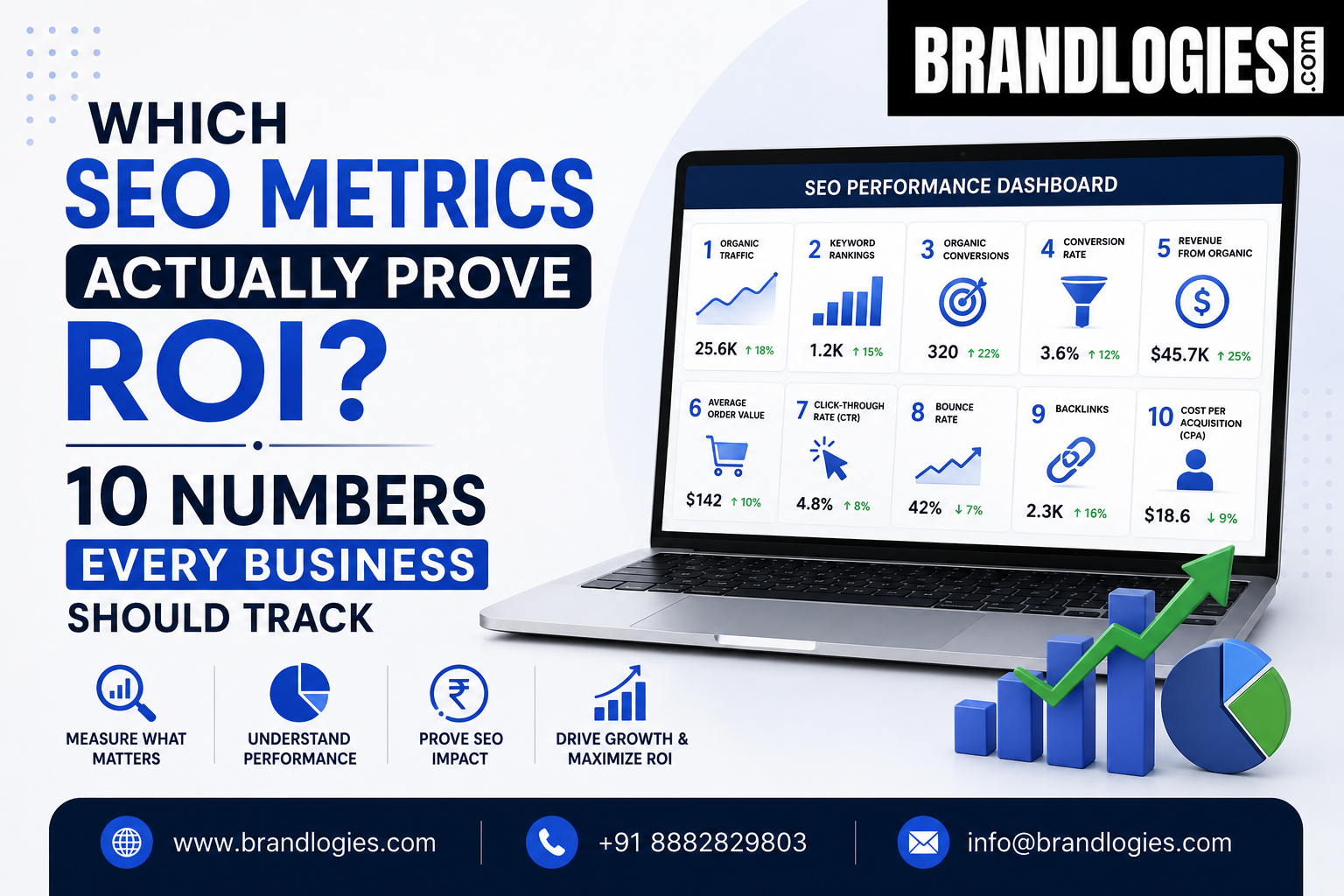
Here are 10 SEO metrics every business should monitor.
1. Organic Traffic
Organic traffic measures the number of visitors reaching your website through unpaid search results.
It is one of the most basic SEO metrics, but it becomes meaningful when you examine the quality of that traffic. Look at which landing pages attract visitors and whether those visitors come from locations and searches relevant to your business.
Increasing traffic is useful, but increasing qualified traffic is even more valuable.
2. Organic Conversions
Traffic becomes more meaningful when visitors take action.
Track conversions such as:
- Contact-form submissions
- Phone calls
- Quote requests
- Demo bookings
- Test-drive requests
- Purchases
- Appointment bookings
Organic conversions provide a clearer connection between SEO activity and business outcomes.
3. Conversion Rate
Your organic conversion rate shows how effectively search visitors become leads or customers.
A website receiving 10,000 organic visitors but generating only 20 leads may need conversion improvements. Another website receiving 2,000 visitors and generating 100 leads could have much stronger commercial value.
This is why SEO metrics should always be considered alongside website performance.
4. Keyword Rankings
Rankings remain useful, particularly for monitoring important commercial and location-based keywords.
However, do not measure success by tracking hundreds of random keywords. Focus on terms that reflect customer intent and have genuine business value.
For example, ranking for “SEO tips” may generate awareness, while ranking for “SEO agency in Delhi” could attract customers actively looking for a service provider.
5. Search Impressions
Search impressions indicate how frequently your website appears in search results.
A rise in impressions can show that your website is becoming more visible, even before clicks increase significantly.
Analyze impressions alongside rankings and click-through rates to understand whether your pages are appearing for the right searches.
6. Click-Through Rate
Click-through rate, or CTR, measures the percentage of search users who click your result after seeing it.
A page ranking well but receiving a low CTR may have an unappealing title or meta description. Improving these elements can sometimes increase traffic without requiring a higher ranking.
This makes CTR an important part of practical SEO analysis.
7. Cost Per Acquisition
Cost per acquisition, or CPA, helps businesses understand how much they spend to acquire a customer.
Compare your SEO investment with the number of customers generated through organic search. While SEO involves upfront and ongoing costs, its long-term acquisition economics can become attractive as organic visibility grows.
For a meaningful calculation, include relevant SEO costs such as agency fees, content production, technical work, and other associated expenses.
8. Revenue From Organic Search
For ecommerce businesses, revenue from organic search is one of the strongest indicators of SEO performance.
Track purchases generated through organic visitors and analyze which landing pages, product categories, and search terms contribute to sales.
For lead-generation businesses, you can assign values to qualified leads and connect organic leads to closed sales using your CRM.
9. Customer Lifetime Value
Not every customer has the same value.
A customer who makes one small purchase may be less valuable than a customer who returns regularly or signs a long-term contract.
Tracking customer lifetime value can provide a deeper understanding of SEO ROI. If organic search consistently attracts customers with strong lifetime value, the channel may be more valuable than traffic numbers initially suggest.
10. SEO Return on Investment
Ultimately, businesses want to know whether their SEO investment is producing a worthwhile return.
A simple approach is to compare the value generated through organic search with the total cost of your SEO activity.
For example, if your SEO program costs ₹1,00,000 and generates ₹3,00,000 in attributable profit or revenue value, the investment can be evaluated against that return.
The exact calculation depends on your business model, margins, attribution system, and sales cycle.
How Brandlogies Uses SEO Metrics
Good reporting should tell a story.
Instead of sending a report containing dozens of numbers without context, Brandlogies focuses on metrics that help businesses understand what is improving, what needs attention, and whether organic search is contributing to meaningful growth.
A strong SEO dashboard can combine rankings, organic traffic, conversions, revenue, lead quality, and acquisition costs. This creates a clearer picture of performance and helps businesses make better marketing decisions.
Stop Measuring SEO by Traffic Alone
SEO success is not simply about getting more people to your website. The real value comes from attracting the right people and turning their searches into meaningful business outcomes.
Track visibility, engagement, leads, sales, and customer value together. When these numbers move in the right direction, you have stronger evidence that your SEO strategy is contributing to ROI.
Brandlogies can help businesses build an SEO strategy and measurement framework focused on visibility, qualified traffic, conversions, and sustainable growth.

FAQs
1. Which SEO metric is most important for ROI?
Organic conversions and revenue are among the most important because they connect search performance directly with business outcomes.
2. Is organic traffic enough to measure SEO success?
No. Traffic shows visibility and acquisition, but it does not tell you whether visitors are becoming leads or customers.
3. How do I calculate SEO ROI?
Compare the measurable value generated from organic search with the total cost of your SEO investment. The exact formula should reflect your revenue model and profit margins.
4. Should businesses still track keyword rankings?
Yes. Rankings are useful for measuring visibility, but they should be combined with conversions, traffic quality, revenue, and other business metrics.
5. How can Brandlogies improve SEO ROI?
Brandlogies can help businesses identify valuable search opportunities, optimize websites and content, improve organic visibility, and track performance against meaningful business goals.
Read Also – Why Ranking #1 Isn’t Enough Anymore: The New SEO Reality