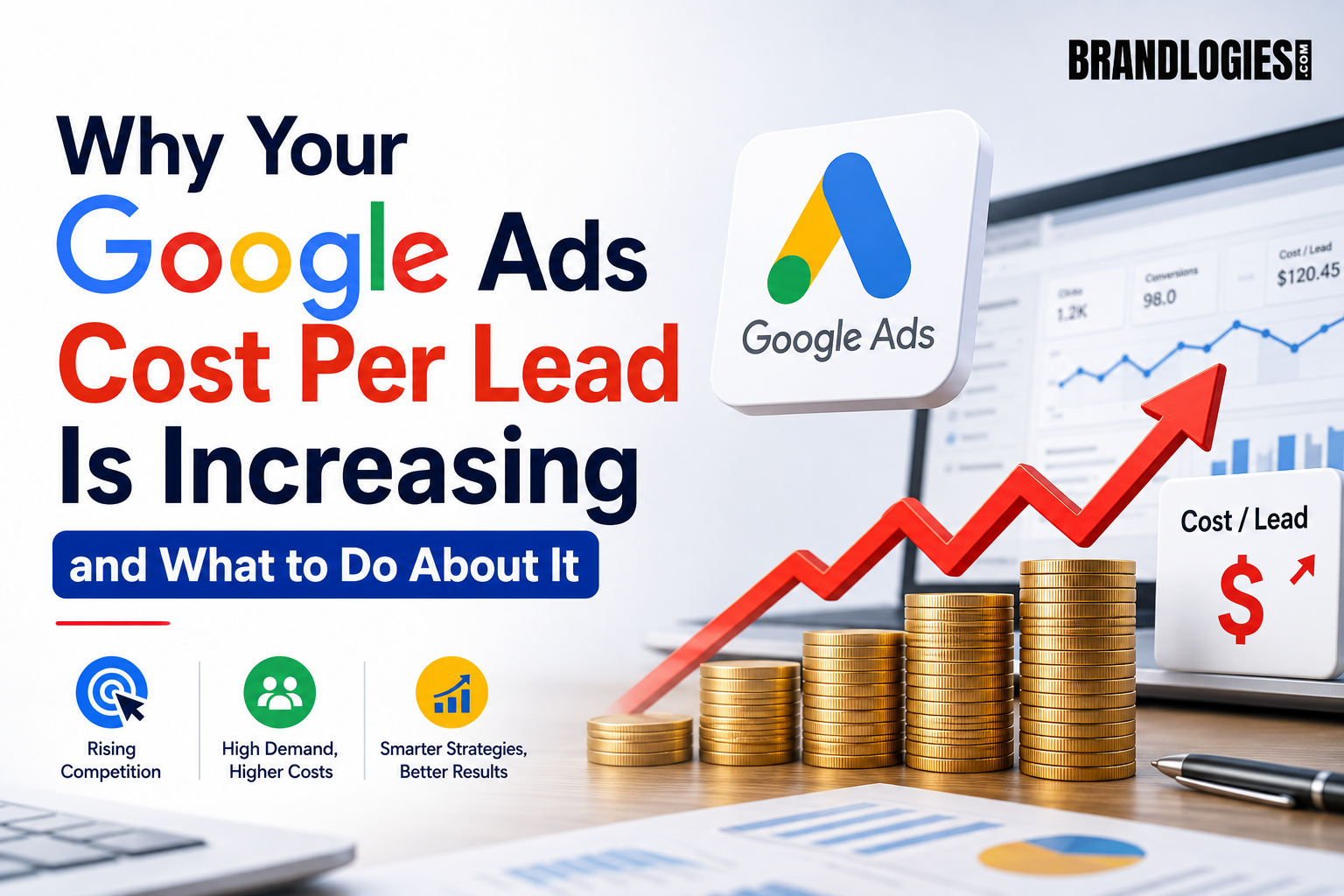
Google Ads can be one of the fastest ways to generate leads, but rising cost per lead (CPL) can quickly make campaigns less profitable. If you are spending the same budget but getting fewer leads, or paying significantly more for each inquiry, the problem may not simply be increasing competition.
Several factors can push your Google Ads CPL upward, including changes in search behavior, poor conversion tracking, expensive keywords, weak landing pages, and inefficient campaign targeting.
Here are the most common reasons your Google Ads cost per lead may be increasing—and what businesses should review.
1. Competition for Your Keywords Has Increased
Google Ads works through an auction. When more businesses start bidding on the same keywords, competition can increase the cost of clicks.
For example, if several competitors begin targeting high-intent keywords such as “digital marketing agency,” “real estate consultant,” or “best IVF center,” advertisers may need to bid more aggressively to remain competitive.
Higher CPC combined with the same conversion rate naturally increases your CPL.
What to check: Compare your current CPC, impression share, and auction insights with previous periods. If competitors are becoming more aggressive, your campaign may need a keyword and bidding strategy update.
2. Your Conversion Rate Has Dropped
CPL depends on two major numbers:
Cost Per Lead = Advertising Spend ÷ Number of Leads
Even if your CPC remains stable, a lower conversion rate can significantly increase CPL.
Suppose your campaign previously generated 20 leads from 100 clicks. If it now generates only 10 leads from the same number of clicks, your cost per lead has effectively doubled.
A conversion-rate decline can happen because of changes to your landing page, website performance, offer, audience quality, or user intent.
Review your conversion rate before simply increasing your advertising budget.
3. Your Landing Page Is Not Converting
Getting clicks is only half the job. Your landing page needs to convince visitors to take action.
Common landing-page problems include:
- Slow loading speed
- Weak or unclear headlines
- Too much information
- Complicated forms
- Poor mobile experience
- Missing trust signals
- Weak calls to action
- Mismatch between the ad and landing page
If your ads promise one thing but the landing page delivers something different, users may leave without submitting an inquiry.
Your landing page should closely match the keyword, advertisement, and user’s search intent.
4. Broad Targeting Is Bringing Low-Intent Traffic
Not every click is equally valuable.
Broad targeting can sometimes attract searches that are related to your business but unlikely to generate a lead. For example, someone searching for “digital marketing course” may click an advertisement from a digital marketing agency even though they are looking for education rather than marketing services.
This creates wasted spend.
Review your Search Terms Report regularly and identify irrelevant searches. Adding negative keywords can prevent your ads from appearing for searches that are unlikely to convert.
5. Your Keywords May Be Too Expensive
High-intent keywords can be valuable, but they can also be highly competitive.
Instead of focusing only on expensive, high-volume keywords, consider a combination of:
- High-intent keywords
- Long-tail keywords
- Location-specific keywords
- Service-specific keywords
- Lower-competition variations
For example, instead of targeting only “SEO services,” a business may test more specific searches such as “SEO services for real estate companies” or “local SEO agency in Delhi.”
The objective is not simply to reduce CPC. It is to find keywords that produce qualified leads at a sustainable cost.
6. Your Ad Copy May Be Losing Relevance
If your ads are not aligned with what users are searching for, they may receive fewer clicks or attract the wrong audience.
Your ad copy should clearly communicate:
- What you offer
- Who you serve
- Your key differentiator
- Why users should choose you
- What action they should take
Test different headlines, descriptions, offers, and calls to action.
Small improvements in ad relevance and click-through rate can contribute to better campaign efficiency.
7. Your Conversion Tracking May Be Incorrect
Sometimes CPL appears to increase because the campaign is not measuring conversions correctly.
For example, if your website generates 30 genuine leads but Google Ads records only 15 conversions, your reported CPL will appear much higher than the actual cost per lead.
Check whether your important actions are being tracked correctly, including:
- Form submissions
- Phone calls
- WhatsApp inquiries
- Appointment requests
- Lead forms
- Other valuable actions
Also make sure duplicate or low-value conversions are not being counted as primary conversions.
8. Your Campaign Has Not Been Optimized Recently
Google Ads campaigns require ongoing optimization. Leaving the same keywords, ads, audiences, and bidding settings unchanged for months can allow performance to decline.
Regular optimization may include:
- Reviewing search terms
- Adding negative keywords
- Testing new ad variations
- Adjusting bids
- Improving landing pages
- Reviewing locations
- Analyzing device performance
- Checking audience quality
- Removing inefficient keywords
The goal should be continuous improvement rather than simply increasing the budget whenever CPL rises.
9. Your Target Location May Be Too Broad
Location targeting can have a major impact on lead quality.
If your business operates only in selected cities, targeting an entire state or country may generate clicks from people you cannot realistically serve.
Review performance by location and identify where your highest-quality leads are coming from. You can then allocate more budget toward locations that generate better results.
How to Reduce Your Google Ads Cost Per Lead
If your CPL is increasing, don’t immediately assume you need a larger budget. Start by identifying where the efficiency is being lost.
A useful review should cover:
- Keyword and search-term performance
- CPC and competition
- Conversion tracking
- Landing-page conversion rate
- Ad relevance
- Location and device performance
- Lead quality
- Campaign bidding strategy
Most importantly, measure cost per qualified lead, not just cost per conversion. A campaign generating inexpensive but irrelevant inquiries may ultimately be more expensive for your business than a campaign generating fewer but higher-quality leads.
Final Thoughts
An increasing Google Ads cost per lead is a signal that your campaign needs attention—not necessarily a reason to stop advertising.
Competition, rising CPCs, declining conversion rates, poor landing pages, broad targeting, and inaccurate conversion tracking can all contribute to higher CPL. By regularly analyzing campaign data and optimizing the entire journey from search query to lead, businesses can improve advertising efficiency and generate more valuable inquiries.
If your Google Ads campaigns are spending more but producing fewer qualified leads, a detailed campaign audit can help identify where your budget is being wasted and what needs to change.
Read Also – Why Your Website Has Low Search Visibility Even After Doing SEO